
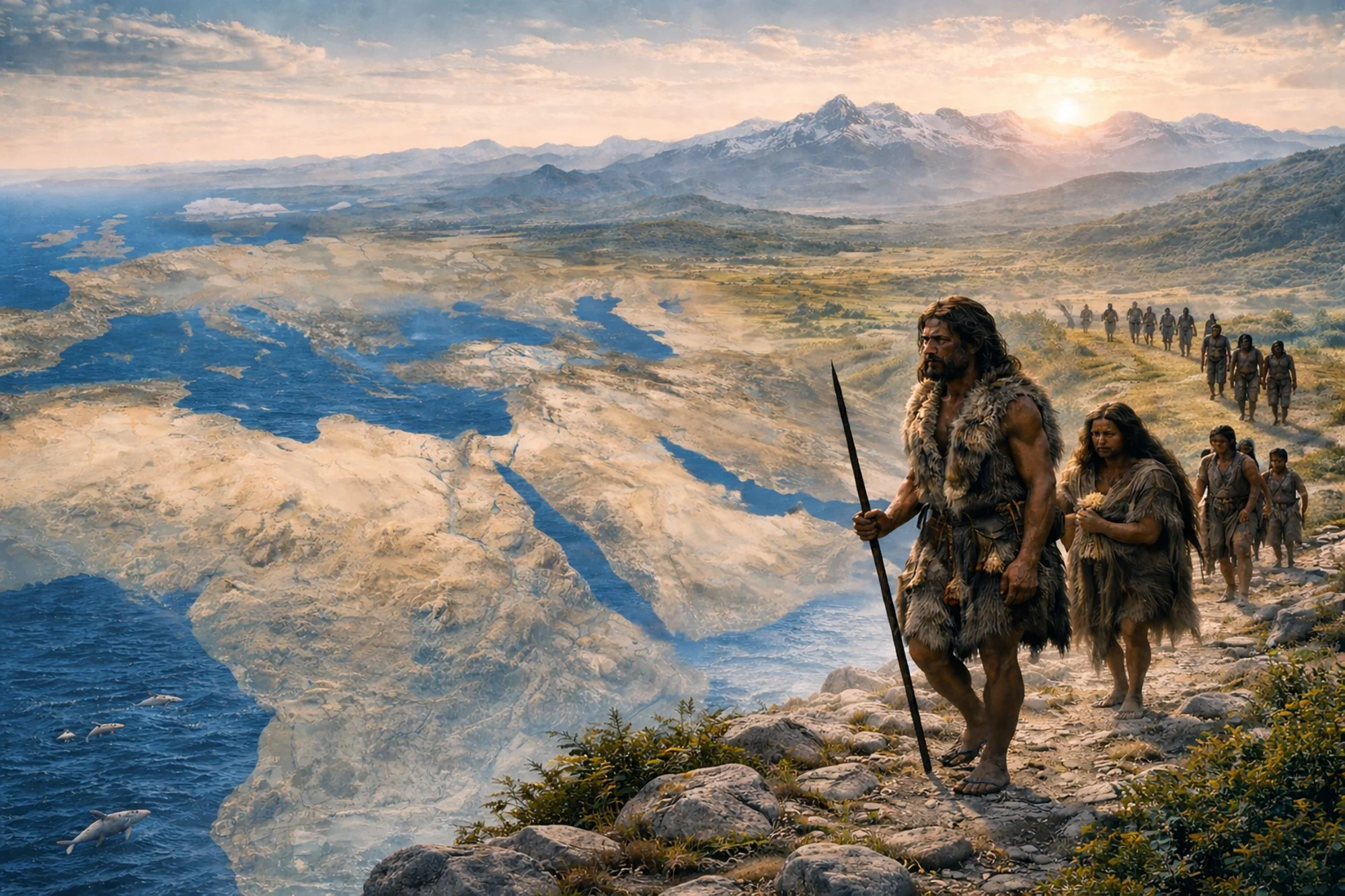
Image created with AI
If we could travel back in time far enough, we would discover that the story of Europe does not begin in Europe at all. It begins in Africa.
For hundreds of thousands of years, Africa was the homeland of the human family. There, our species — Homo sapiens — slowly emerged from earlier human relatives. Only much later did small groups begin to move beyond that continent. Their journeys would eventually bring them to Europe, shaping the deep prehistory of the continent.
The story is not a straight line. It is more like a branching river, with different human species appearing, spreading, and sometimes disappearing.
The Deep Roots of Humanity
The human story begins millions of years ago, when the ancestors of humans split from the lineage that would later become chimpanzees. Over time, several early human relatives appeared in Africa. Some walked upright, some used simple tools, and many lived in environments very different from those we know today.
Around two million years ago, members of the genus Homo began spreading out of Africa for the first time. One of the most successful of these early travellers was Homo erectus. These early humans expanded into the Middle East and Asia, and eventually reached parts of southern Europe.
But they were not yet Homo sapiens.
For a long time, Europe was inhabited by other human species — including the ancestors of Neanderthals — who adapted to the continent’s cold winters and highly seasonal environments.
The First Humans in Europe
Humans have been present in Europe for roughly one to one and a half million years, although these earliest Europeans were not modern humans. They belonged to earlier species such as Homo antecessor and Homo heidelbergensis.
Life in Europe was challenging. The climate fluctuated dramatically during the Ice Ages, with repeated cycles of glacial cold and warmer periods. Early humans had to adapt to short winters, migrating animals, changing vegetation, and unpredictable landscapes.
Survival required flexibility: hunting large animals, exploiting seasonal plant foods, and learning how to navigate complex environments. These early Europeans developed technologies such as stone handaxes and gradually learned to cope with cold climates.
The Arrival of Homo Sapiens
Modern humans evolved much later, probably in Africa around 300,000 years ago. For tens of thousands of years, Homo sapiens remained largely within Africa. Then something changed. Around 60,000–70,000 years ago, groups of modern humans began leaving Africa in larger numbers. These migrations followed several possible routes: along the coasts of the Arabian Peninsula, through the Near East, and eventually into Eurasia. Europe was one of the last major regions to be reached. Modern humans arrived there roughly 45,000 years ago.
But they did not arrive in an empty land. Europe was already home to Neanderthals, who had lived there for hundreds of thousands of years. For several millennia, both species shared the continent. Archaeological and genetic evidence shows that they even interbred. Today, many people outside Africa still carry small amounts of Neanderthal DNA.
A Continent of Encounters
The arrival of Homo sapiens changed Europe’s human landscape. Modern humans brought new cultural traditions — including sophisticated stone tools, symbolic art, ornaments, and eventually the famous cave paintings of places like Lascaux and Altamira. Over time, Neanderthals disappeared, around 39,000 years ago. The reasons are still debated. Climate change, competition for resources, small population sizes, and cultural differences may all have played a role.
After that moment, Europe belonged to a single human species.
Us.
A Much Older Europe than we Imagine
When we walk through European landscapes today — across the plains of France, the mountains of Spain, or the forests of Germany — we are moving through places that humans have inhabited for an astonishingly long time.
Long before cities, long before farming, long before written history, small groups of humans were already travelling through these landscapes. They followed migrating animals, searched for flint to make tools, and gathered around fires during long winter nights.
The arrival of Homo sapiens in Europe was not a sudden event. It was the final chapter of a journey that began hundreds of thousands of years earlier in Africa — a journey that eventually spread our species across the entire planet. And Europe was only one stop along the way.
Further Reading
Wil Roebroeks – The human colonisation of Europe: where are we?
José María Bermúdez de Castro et al. – The Early Pleistocene Human Occupation of Europe
Hosfield & Cole – Early hominins in north-west Europe: A punctuated long chronology?
Natural History Museum – Modern humans, Homo sapiens: When, where and how did we evolve?
Natural History Museum – The origin of our species
Robert Hosfield – The Earliest Europeans: A Year in the Life
Chris Stringer – The Origin of Our Species
Clive Gamble – The Palaeolithic Settlement of Europe