
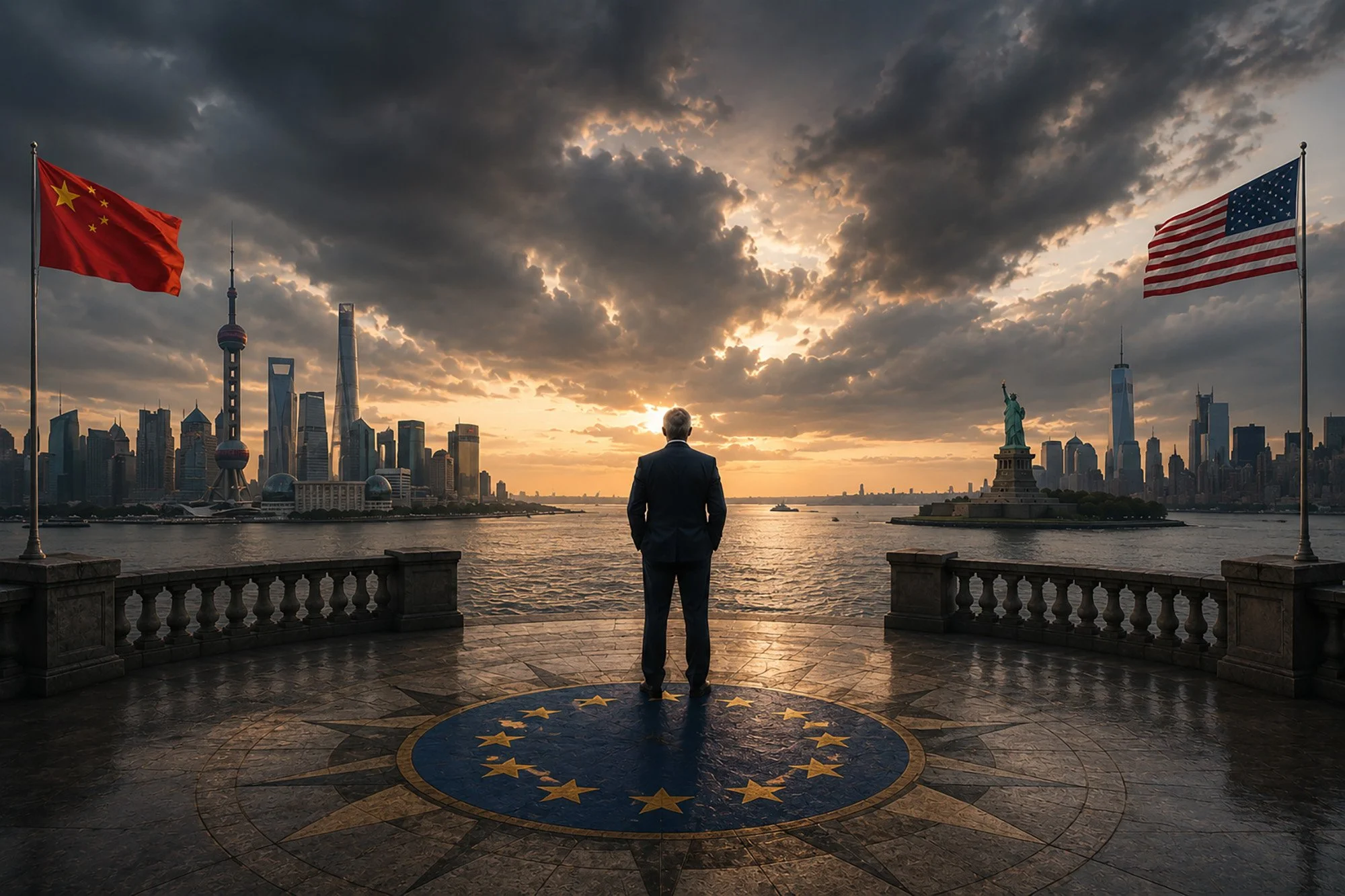
Image created with AI.
For centuries, Europe stood at the center of global power. Even after two world wars, the continent remained closely tied to American power and to a global economy shaped largely on Western terms. Globalization, free trade and technological progress seemed to confirm the idea that the future would gradually become more interconnected — and, in many ways, more Western.
That confidence is evaporating.
Europe now watches a world in which power is shifting rapidly toward Asia, while the rivalry between China and the United States grows more intense. China has moved from being the factory floor of globalization to becoming a technological and industrial power with its own long-term ambitions. The United States remains dominant in finance, software, military power and digital platforms, but increasingly acts according to its own strategic interests, even when those interests are not aligned with Europe’s.
The uncomfortable reality for Europe is that it depends heavily on both.
European industries rely on China for batteries, rare earths, solar panels and industrial supply chains. At the same time, Europe depends on American software, cloud infrastructure, digital platforms and military protection. What once looked like healthy interdependence increasingly feels like vulnerability.
Part of Europe’s problem is internal. While China invested aggressively in infrastructure, industrial ecosystems and strategic technologies, Europe focused heavily on regulation, market rules and financial stability. While American firms built globally dominant digital platforms, Europe often struggled to turn innovation into companies capable of scaling internationally.
The contrast is becoming painfully visible. German carmakers, long symbols of European industrial strength, now face fierce competition from Chinese electric vehicle manufacturers. Europe helped shape the modern environmental transition, yet much of the battery production and critical mineral processing behind that transition now lies elsewhere. In digital life, most Europeans depend daily on American operating systems, cloud services and online platforms.
This does not mean Europe is weak or irrelevant. The European economy remains one of the largest in the world, with advanced industries, strong universities and highly skilled populations. But Europe often appears fragmented in a world where scale matters more and more. Chinese companies benefit from enormous domestic markets and state coordination. American firms operate inside a unified financial and technological system. Europe still works through layers of national interests, regulations and political compromises.
The war in Ukraine accelerated Europe’s awakening. Cheap Russian gas disappeared almost overnight, supply chains proved fragile, and dependence itself became a geopolitical risk. As a result, Europe has started rediscovering industrial policy, investing more heavily in defense, energy infrastructure, semiconductors and AI.
At the same time, Europe risks misunderstanding China if it sees only threat and competition. China’s rise also reflects something the West long underestimated: the importance of long-term planning, infrastructure investment and industrial coordination. Entire Chinese cities have been transformed around advanced transport systems, AI integration, manufacturing and logistics at a scale difficult to imagine in much of Europe.
China, of course, has its own vulnerabilities — debt, demographic decline, overcapacity and political centralization among them. But the larger reality remains: the global balance of power is changing.
The world that shaped Europe’s prosperity after the Cold War is disappearing. Economic globalization is becoming geopolitical. Technology is becoming strategic. Supply chains are becoming instruments of power.
The United States still speaks like a superpower determined to preserve its dominance. China increasingly acts like a civilization-state convinced its historical moment has returned. Europe, meanwhile, is searching for direction in a world it no longer shapes as confidently as it once did.