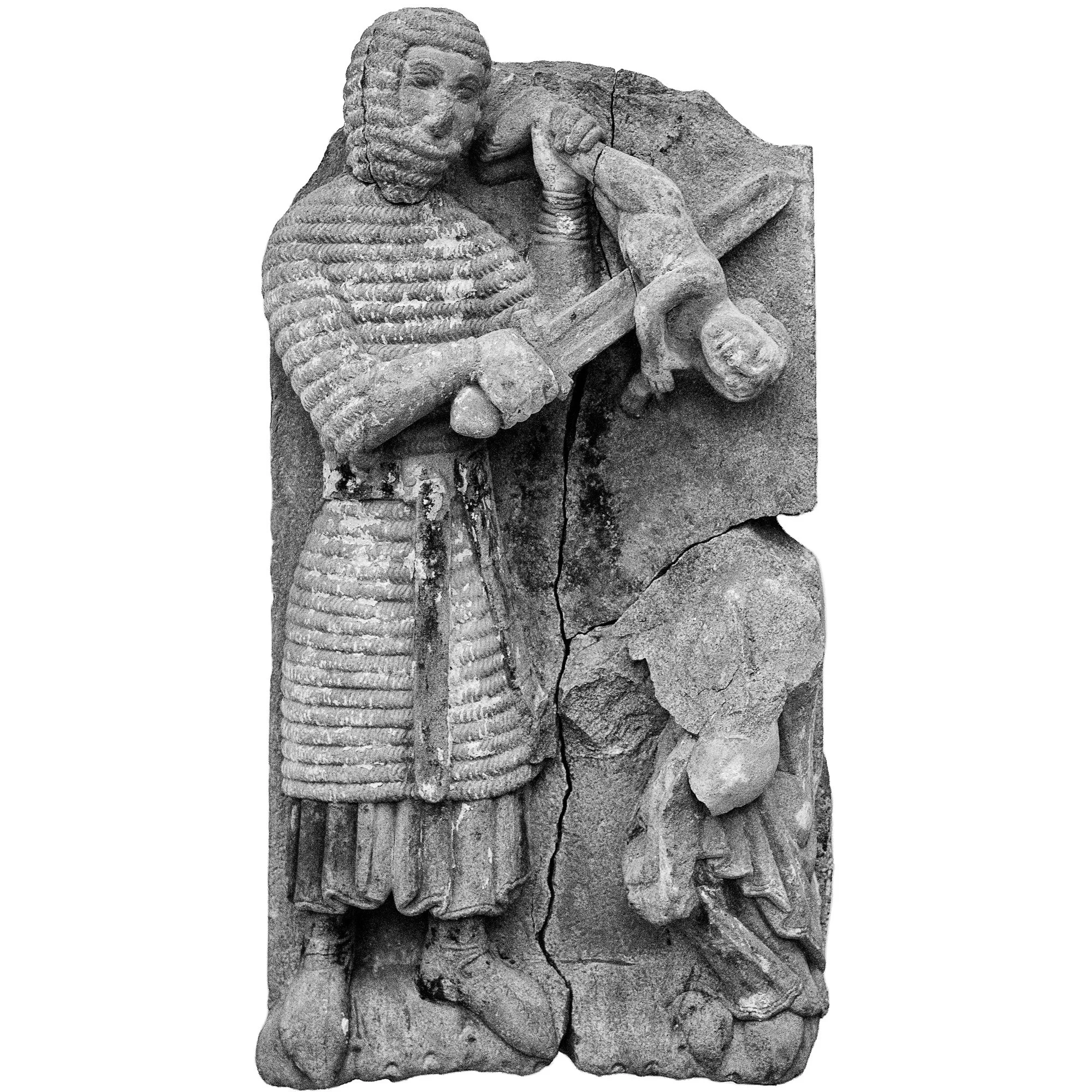
A rediscovered medieval sculpture of the Massacre of the Innocents from Cathedral of Santiago de Compostela, carved around 1250–1350 in the tradition of Master Mateo.
In 2021, archaeologists working beneath the Cathedral of Santiago de Compostela made a remarkable discovery. Hidden for centuries beneath the floor of the cathedral, they uncovered a series of medieval relief sculptures connected to one of the darkest episodes in the Bible: the Massacre of the Innocents.
Among the fragments was a dramatic sculpture of a soldier, carved in granite and still bearing traces of medieval paint. The sculpture originally formed part of a larger decorative cycle inside the cathedral, although its precise original location is no longer known. At some point in history, the artwork had lost its importance and was reused simply as building material in the crypt below the Pórtico da Gloria.
The scene comes from the Gospel of Matthew. After hearing from the Wise Men that a new “king of the Jews” had been born, King Herod reacted with fear and rage:
“Then Herod, when he saw that he had been tricked by the wise men, became furious, and he sent and killed all the male children in Bethlehem and in all that region who were two years old or under.” — Matthew 2:16
For medieval artists, the Massacre of the Innocents was one of the most emotionally powerful episodes from the childhood of Christ. It combined political fear, violence, innocence, and suffering — themes that resonated strongly in medieval religious culture.
The Santiago sculptures follow the visual traditions that had become common across medieval Spain. Artists emphasized movement, emotion, and brutality. Even though the rediscovered fragment is damaged, the aggressive posture of the soldier still carries enormous force. The work reflects the transition from the older Romanesque tradition associated with Master Mateo toward the more emotional and expressive Gothic style emerging during the thirteenth and fourteenth centuries.
What makes the discovery especially striking is the fate of the sculpture itself. Once part of the decoration of one of Europe’s greatest pilgrimage churches, it eventually disappeared from sight and survived only because it had been recycled into the cathedral’s construction. Sacred art became rubble.
And yet the sculpture survived.
Today, the fragment offers more than a glimpse into medieval religious art. It also reveals how medieval Europe understood power and violence. Herod’s massacre was not treated as a distant historical episode, but as a deeply human tragedy — one that artists believed should be remembered in stone.
There is something fitting in the fact that these forgotten sculptures have finally re-emerged into the light. A work of art about forgotten victims was itself forgotten for centuries beneath the cathedral floor.