
Imagine setting off on a journey with almost nothing.
No horse. No money. No comfortable inn waiting at the end of the day. Only a simple brown habit, a rope around your waist, a pair of worn sandals, and complete trust that God—and the kindness of strangers—would provide what you needed.
For many Franciscan friars in the thirteenth century, this was everyday life.
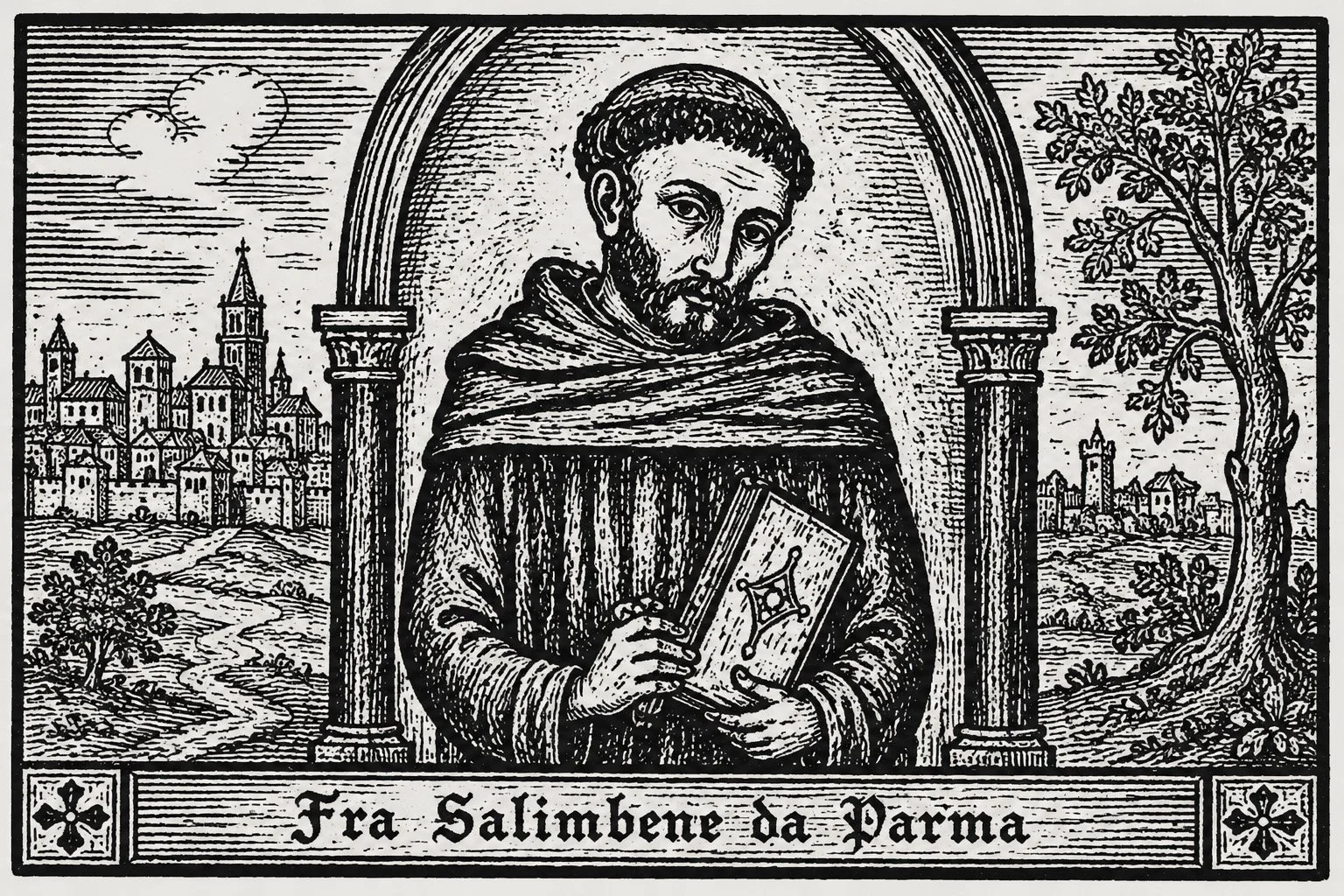
One of them was Salimbene de Adam (1221–c.1290), a Franciscan friar from Parma, Italy. During his lifetime he travelled extensively through Italy and France, recording the people, places and events he encountered. His lively Cronica is one of the most personal and engaging accounts of medieval Europe, offering a rare glimpse into life on the road nearly eight centuries ago.
A Europe Without Hotels
Unlike monks who spent their lives in a single monastery, Franciscans were expected to travel wherever they were needed.
Salimbene walked from city to city, visiting places such as Parma, Bologna, Lucca, Siena, Pisa, Genoa, Ferrara, Modena and Lyon (in France). Roads were often little more than muddy tracks. Rivers could become impassable after heavy rain, bridges were unreliable, and bandits were an ever-present danger.
Yet these journeys opened the door to an extraordinary world.
A Collector of Stories
Salimbene had a remarkable eye for people.
His chronicle introduces us to emperors, bishops and popes, but also to merchants, cooks, fellow friars, wandering preachers and ordinary townspeople. Some are wise, others vain or comical, but almost all are vividly portrayed.
Rather than listing dates and battles, Salimbene fills his pages with conversations, humorous anecdotes and memorable encounters. Reading his work often feels like travelling alongside a companion who never runs out of stories.
Living on the Kindness of Others
Franciscans embraced a life of poverty. They owned almost nothing and relied on the hospitality of the communities they visited.
Families offered meals, monasteries provided a bed for the night, and local people welcomed the friars because they preached, cared for the sick and supported the poor. Hospitality was not simply an act of kindness—it was an essential part of medieval society that allowed travellers, pilgrims and friars to cross Europe.
Carrying News Across Europe
Travelling friars did more than preach.
They also carried information.
As Salimbene moved from one town to another, he gathered news about wars, royal marriages, papal elections, miracles and disasters. He spoke with eyewitnesses, compared different accounts and passed these stories on during his next journey.
Long before newspapers existed, travelling friars formed part of Europe's living communication network.
Following Salimbene Today
Many of the places Salimbene visited have changed surprisingly little.
Walking through the historic centres of Parma, Bologna, Lucca or Siena, you can still imagine a weary Franciscan arriving at the city gate after days on foot. Before long, he would have found the local convent, shared a simple meal, exchanged news with fellow friars and set off again with fresh stories to tell.
Salimbene's Cronica reminds us that travel has always been about more than reaching a destination. It is about curiosity, meeting new people, and returning home with stories worth sharing.