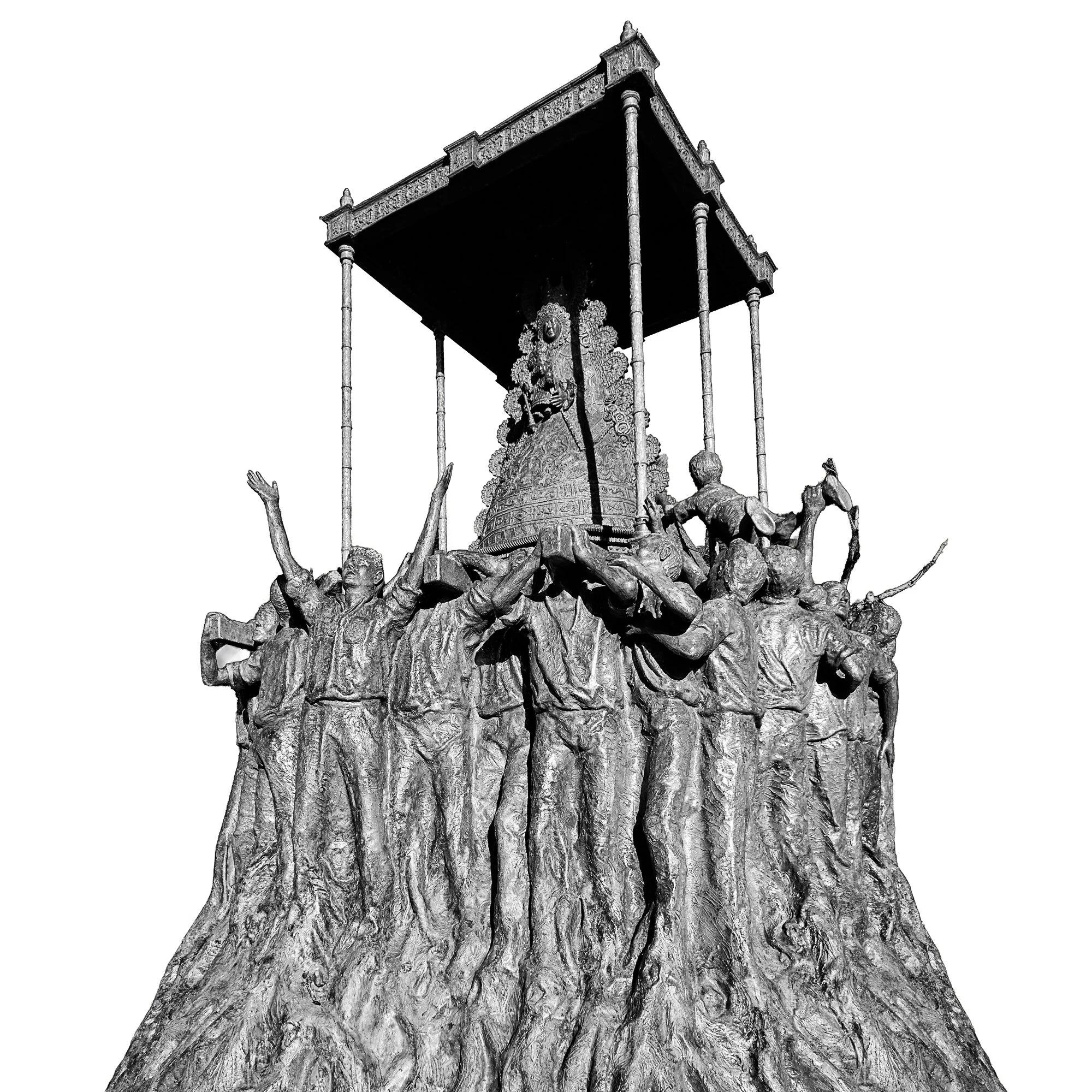
The Monumento a la Virgen del Rocío in Sanlúcar de Barrameda (Spain).
In Sanlúcar de Barrameda, not far from the river and the routes pilgrims have followed for centuries, stands the Monumento a la Virgen del Rocío. At first glance it is a familiar Andalusian sight: a statue of the Virgin, enclosed by an elegant iron fence. But look more closely, and the fence becomes the real focus. Small cards, ribbons, photographs and holy images are tied to it—quiet traces left behind by people who stopped here for a moment.
To understand this place, you have to look beyond Sanlúcar to El Rocío, one of Spain’s most powerful centres of Marian devotion. Each year, during the great pilgrimage, thousands travel there on foot, on horseback, or in decorated wagons. Many come as part of religious brotherhoods—hermandades—that link towns across Andalusia to the shrine. Sanlúcar has long been part of this network. Its own brotherhood has, for generations, joined the journey, carrying with it the traditions and emotions of the city.
The monument is a local expression of that wider world. It brings a trace of El Rocío into the everyday life of Sanlúcar—a reminder that devotion is not limited to the pilgrimage itself. Yet what makes this place distinctive is not only the statue, but what gathers around it.
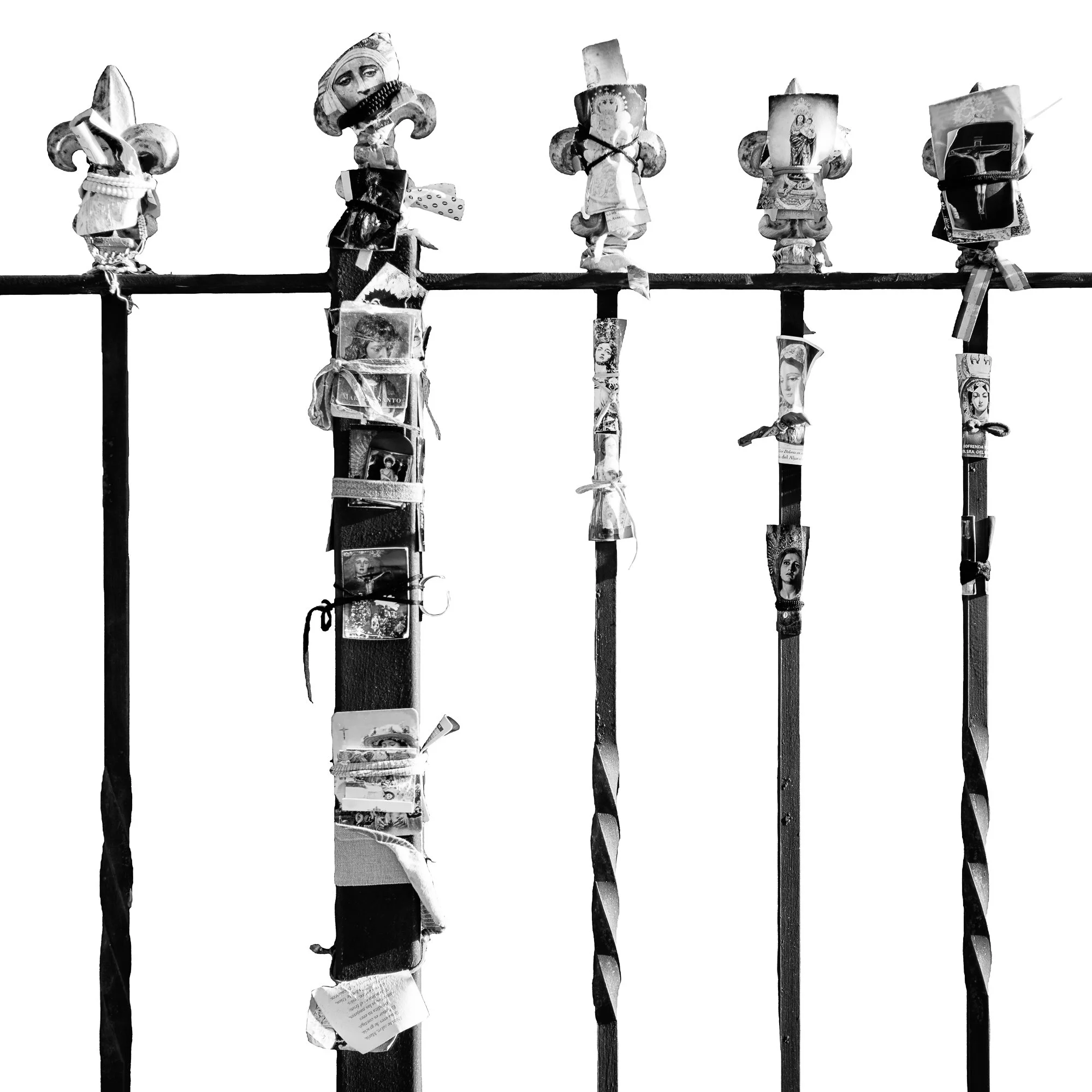
The fence with ex-voto’s around the Monumento a la Virgen del Rocío in Sanlúcar de Barrameda (Spain).
In Andalusia, iron grilles—rejas—often mark the boundary of a sacred space. They separate, but also invite. Here, that boundary becomes a point of contact. People tie small objects to the fence: a photograph, a ribbon, a prayer card, sometimes just a handwritten note. These are a form of ex-voto, offerings made in hope or gratitude. Unlike the traditional silver objects or painted panels found in churches, these are simple, temporary, and deeply personal. As they accumulate, fade, and are replaced, they give the monument a quiet, changing life of its own.
Standing by the fence, you sense that connection. The great pilgrimage to El Rocío is collective, almost overwhelming in scale. Here in Sanlúcar, it is reduced to a quieter gesture: a ribbon tied, a card left behind. And in that small act, the distance between the city and El Rocío seems to shrink.