
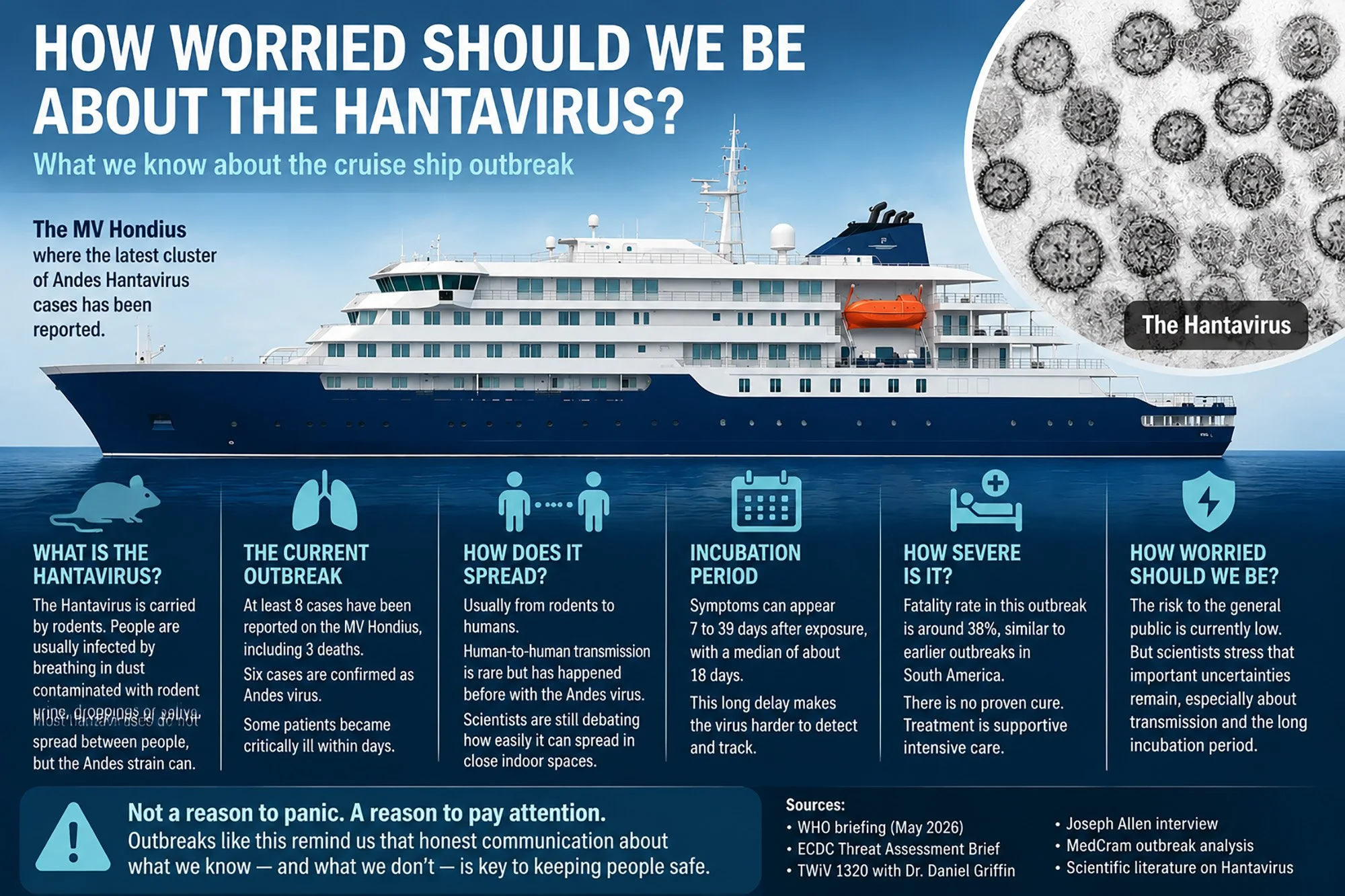
Image created with AI.
Three people are dead. Several others became seriously ill within days. Doctors in different countries are now tracing passengers who shared dining rooms, lecture halls and cabins aboard a cruise ship crossing the South Atlantic.
Even so, the official tone around the current outbreak of the Hantavirus has remained surprisingly calm. Health authorities continue to say that this is “not another COVID,” and that the risk to the wider public is low. That may eventually prove true. But some scientists are becoming uncomfortable with how strongly that reassuring message is being pushed while important questions still remain unanswered.
The real issue is not whether people should panic. They should not. The more important question is whether the public is hearing the full scientific story, including the uncertainties.
What Is the Hantavirus?
The Hantavirus is normally spread from rodents to humans through contaminated dust, urine or droppings. In most cases, the virus does not spread from one person to another. The current outbreak, however, involves the Andes strain of the Hantavirus, a rare version found in South America that is known to be capable of limited human-to-human transmission.
What worries scientists is not just the virus itself, but the combination of characteristics it appears to have. The Andes strain can cause very severe illness and has a relatively high fatality rate. At the same time, the virus may have a long incubation period and may sometimes spread between people in enclosed spaces.
Modern epidemiologists increasingly look at these combinations of factors rather than at one number alone. A recent study from the London School of Hygiene & Tropical Medicine argues that the danger of an outbreak depends on how severity, transmissibility and incubation time work together.
A virus does not need to spread as easily as measles to become a serious problem. If infected people can travel internationally for days or even weeks before realizing they are ill, controlling an outbreak becomes much harder.
Why the Cruise Ship Outbreak Matters
Cruise ships are almost perfect environments for studying outbreaks. Large numbers of people share air, dining rooms and social spaces while constantly moving between countries.
According to WHO and ECDC reports, several people aboard the MV Hondius quickly developed severe respiratory symptoms, pneumonia and shock. Three people died.
The current outbreak appears to have a fatality rate close to 38%, although the number of confirmed cases is still small. Earlier outbreaks in South America showed similar numbers.
Those figures are striking. COVID-19 was far less deadly for the average patient. What made COVID so destructive was not mainly its fatality rate, but the fact that it spread very efficiently before people became seriously ill.
Right now, there is no evidence that the Hantavirus spreads anywhere near as easily as COVID-19. But some researchers fear that we may not yet fully understand how the Andes strain behaves in crowded indoor environments.
The Debate About Transmission
Official WHO and ECDC guidance says that person-to-person transmission of the Andes strain mainly happens after close and prolonged contact, especially between household members or caregivers.
Harvard scientist Joseph Allen has publicly questioned that interpretation. After reviewing earlier scientific studies and speaking directly with a doctor aboard the ship, Allen argued that some infections may have happened without what most people would describe as “close contact.” In interviews, he described reports of infected passengers who had simply shared indoor spaces such as dining rooms or lecture halls.
Allen is not saying that the Hantavirus is about to become a global pandemic. His argument is more limited, but still important. He believes that official communication may sound more certain than the science really is.
That debate will sound familiar to many people after COVID. Governments often try to avoid panic by reassuring the public. But if the message becomes too reassuring too early, many people stop paying attention exactly when careful attention is still needed.
The Problem of the Long Incubation Period
Another reason scientists are watching this outbreak closely is the incubation period. Research on the Andes strain suggests that symptoms can appear anywhere from 7 to 39 days after exposure, with a median of around 18 days.
That creates a long period of uncertainty. Passengers may board flights, stay in hotels and return home long before they realize they are infected. WHO has warned that additional cases may still appear because the incubation period can extend to six weeks.
Long incubation periods do not automatically create pandemics. But they do make outbreaks harder to trace and control in a world where international travel is constant.
Is There a Treatment?
At the moment, there is no proven antiviral treatment for the Hantavirus. Doctors mainly rely on supportive intensive care, including oxygen therapy, ventilation and, in severe cases, ECMO. Patients can deteriorate very quickly once serious respiratory symptoms begin.
That alone is enough reason for doctors and epidemiologists to take even relatively small outbreaks seriously.
So, How Worried Should We Be?
At this stage, there is still no evidence that the Hantavirus poses a COVID-scale threat to the world. But there is also enough uncertainty that simple reassurance may not tell the whole story.
The outbreak aboard the MV Hondius is a reminder that outbreaks are shaped not only by biology, but also by how uncertainty is communicated. The real debate is not about panic versus calm. It is about whether modern societies are able to handle nuance: a virus can simultaneously be unlikely to become a global catastrophe and still deserve serious scientific concern.