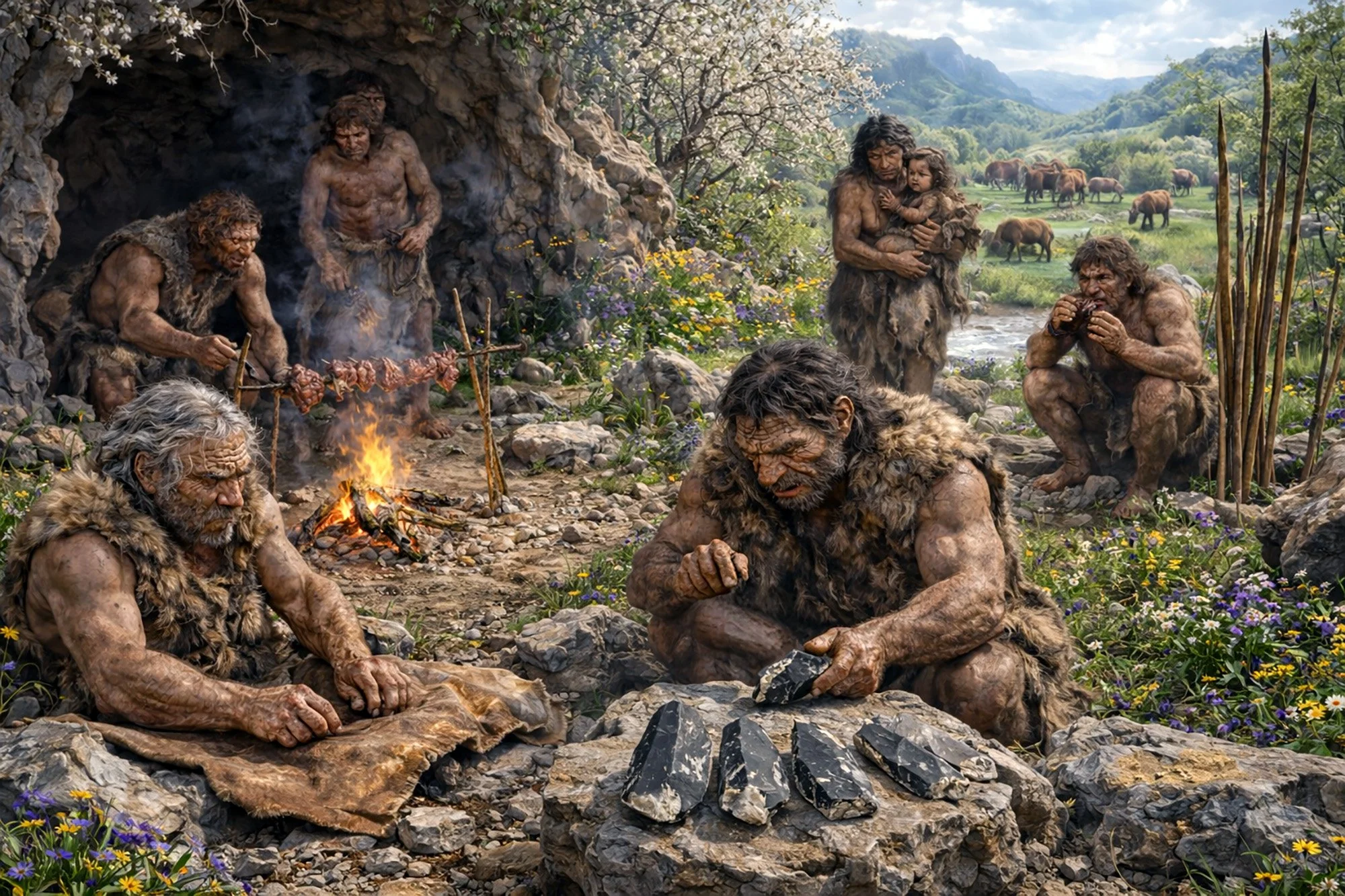
Neanderthals in Spain (An impression, generated with AI).
A valley, 100,000 years ago
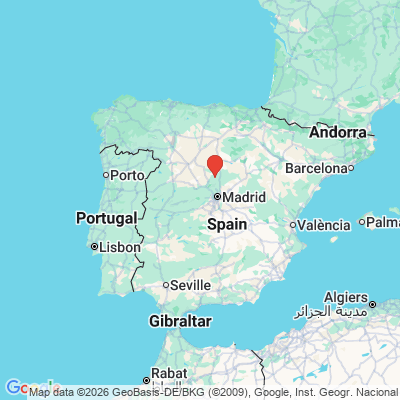
Around 100,000 years ago, long before cities, farming, or even modern humans reached much of Europe, groups of Neanderthaler lived in what is now central Spain. In a valley north of present-day Madrid—today known as the Valle de los Neandertales—they found something rare: a landscape that offered everything they needed to survive.
This was not a paradise in the modern sense, but it was perfectly suited to their way of life. There was water from the river, open land where herds of horses, deer, and bison grazed, caves and rock shelters for protection, wood for fire, and stone for tools. Because all these elements came together in one place, Neanderthals kept returning here over tens of thousands of years, making the valley not just a temporary stop, but a recurring home.
Skilled hunters in a crowded world
The people who lived here were not primitive in the way they were once imagined. They were experienced hunter-gatherers who understood their environment in detail and adapted to it with remarkable flexibility. Much of their life revolved around hunting the large grazing animals that moved through the valley—horses, deer, bison, and at times even larger prey such as wild cattle or rhinoceroses.
They worked together to hunt, butcher, and process these animals, using tools shaped from whatever stone was available. In this region, that often meant quartz—far from ideal, but nearby and sufficient for their needs.
At the same time, they were not alone in relying on these herds. Lions, hyenas, and leopards hunted the same animals, turning the landscape into a shared and often contested space. Survival depended not only on skill, but also on timing, cooperation, and an ability to navigate this competition. When large prey was available, Neanderthals focused on it, suggesting a preference for efficiency and planning rather than opportunistic scavenging.
A mind not so different from ours
What makes these Spanish sites especially compelling is not just how Neanderthals lived, but what they may have thought. Among the discoveries is the burial of a very young child, carefully placed in the ground. Nearby traces of fire suggest that this was not a random event, but something intentional.
This changes the story. It points to care for others, even after death, and perhaps to early forms of ritual or symbolic thinking. In fact, Neanderthals in Europe may have buried their dead long before modern humans did in other regions, suggesting that emotional and social complexity were already part of their world.
Over time, research has shifted from asking how Neanderthals survived to asking how they understood their world. They were not simply enduring life—they were experiencing it.
A disappearing world
Neanderthals lived across Europe, including the Iberian Peninsula, for hundreds of thousands of years. Then, around 40,000 years ago, they disappeared. The causes were likely complex: changing climates, shrinking populations, and competition with incoming modern humans all played a role. Rather than a sudden extinction, it seems to have been a gradual fading of small, vulnerable groups.
Walking through their world
Standing in that quiet Spanish valley today, it is hard to imagine the life that once filled it. But once you know the story, the landscape begins to shift. It becomes a place of fires and movement, of hunters watching herds cross the valley, of families gathering in the shelter of rock and cave.
And perhaps, more than anything, it becomes a place where the distance between them and us feels surprisingly small.