A helmet, a painted bowl and the story of an ancient trading world
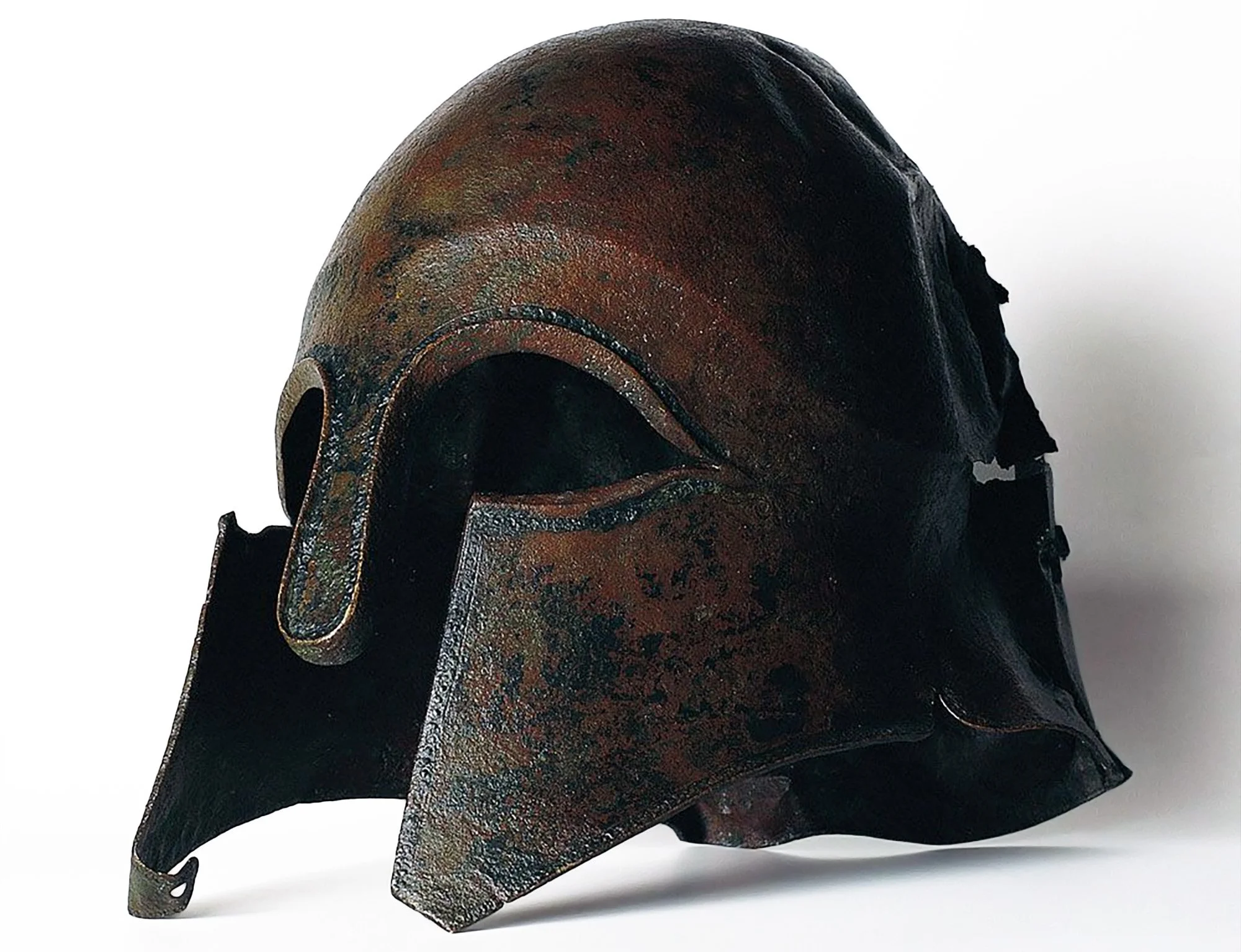
The Corinthian helmet found in the estuary of Huelva in 1930 — a reminder that this Atlantic port was already connected to the wider Mediterranean world over 2,500 years ago (Museo Arqueologico Nacional, Madrid photo by the Real Academia de la Historia).
It all began with a chance discovery. In 1930, during dredging works in the estuary of Huelva (Spain), a Corinthian bronze helmet emerged from the mud. For a long time, it was treated as an isolated object — a curiosity without context.
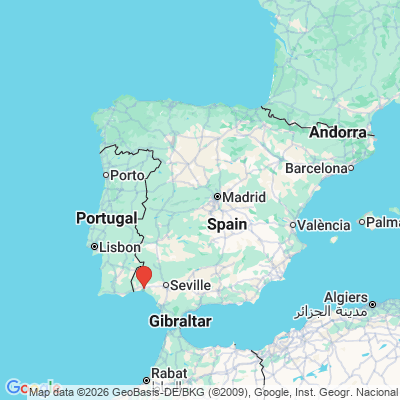
But Huelva is a city that hides its past well. Beneath its modern streets lies an ancient settlement that, as archaeological research shows, was already active around 900–770 BC . What first appeared as a single find now forms part of a much larger picture: a place where goods, people and ideas moved across long distances — and where even foreign styles, such as Greek pottery, were sometimes reproduced locally.
A port at the crossroads of worlds
Excavations have revealed thousands of artefacts — ceramics, tools and industrial remains — pointing to a settlement deeply embedded in long-distance exchange networks. Phoenician, local and Greek materials appear side by side, not as rare imports but as part of a continuous flow of goods and ideas.
The region’s wealth explains why. The nearby mining areas, especially Riotinto, produced vast quantities of metals, particularly silver. This attracted traders, craftsmen and specialists of all kinds. The archaeological record shows a community engaged in metalworking, woodworking and ivory processing, all tied to wider Mediterranean connections .
The Greeks would later call this place Tartessos, a name associated with wealth and distant trade. Whether myth or memory, the description fits remarkably well: a densely inhabited settlement, economically vibrant and outward-looking, positioned at the edge of the known world.
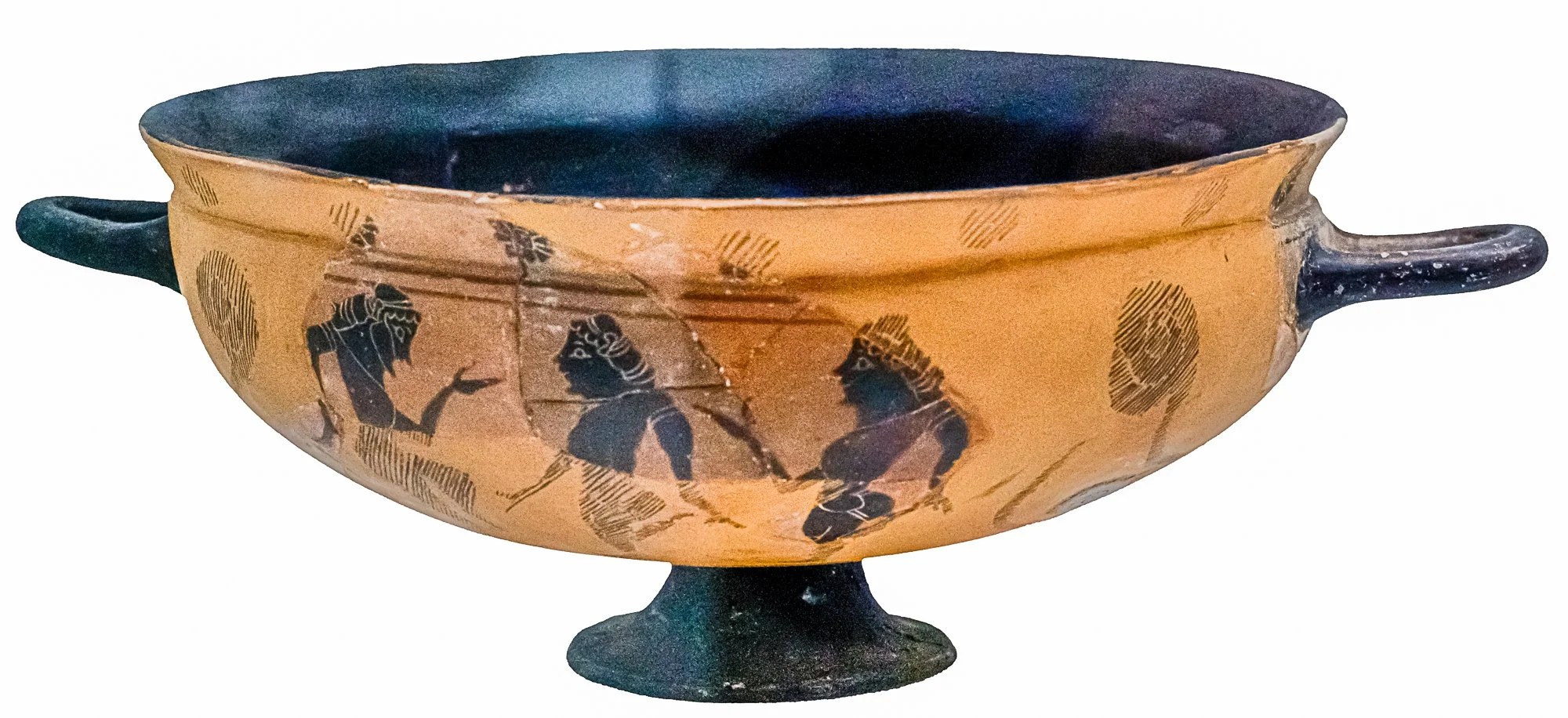
A Greek-style drinking bowl (kylix): objects like this travelled across vast trade networks, but some were also made locally in Huelva, showing how foreign traditions were adopted and re-created far from their origins (Museo de Huelva).
Objects that travelled — and were remade
The helmet is not alone. Greek ceramics — including finely decorated drinking vessels — have been found in significant numbers in Huelva. These objects are not just decorative; they are evidence of movement, exchange and contact.
What makes them particularly interesting is how they arrived. The archaeological context suggests that many of these Greek goods were not brought directly by Greek settlers, but travelled through Phoenician trade networks that connected the eastern Mediterranean with the Atlantic coast .
Yet the story goes a step further. Scientific analyses have shown that some of these ceramics, although Greek in style, were actually produced locally using clays from the Huelva region. This suggests that Greek craftsmen — or artisans trained in Greek techniques — were active here, reproducing familiar forms far from their original homeland.
Huelva, then, was not simply a place where goods arrived. It was a place where traditions were adapted and re-created. Not a Greek city, nor purely Phoenician, but a shared economic and cultural space in which influences blended. Everyday objects — a bowl, a cup, a helmet — became carriers of connection across vast distances.
From emporium to legend
Over time, this network weakened. Trade routes shifted, activity declined, and the once-busy port faded from prominence. What remained were fragments — buried in mud, scattered beneath the modern city.
Yet these fragments tell a clear story. Long before formal empires shaped the Mediterranean, there already existed a connected world of exchange, driven by resources, trade and human curiosity.
Huelva was one of its key gateways — the port behind the legend of Tartessos.