
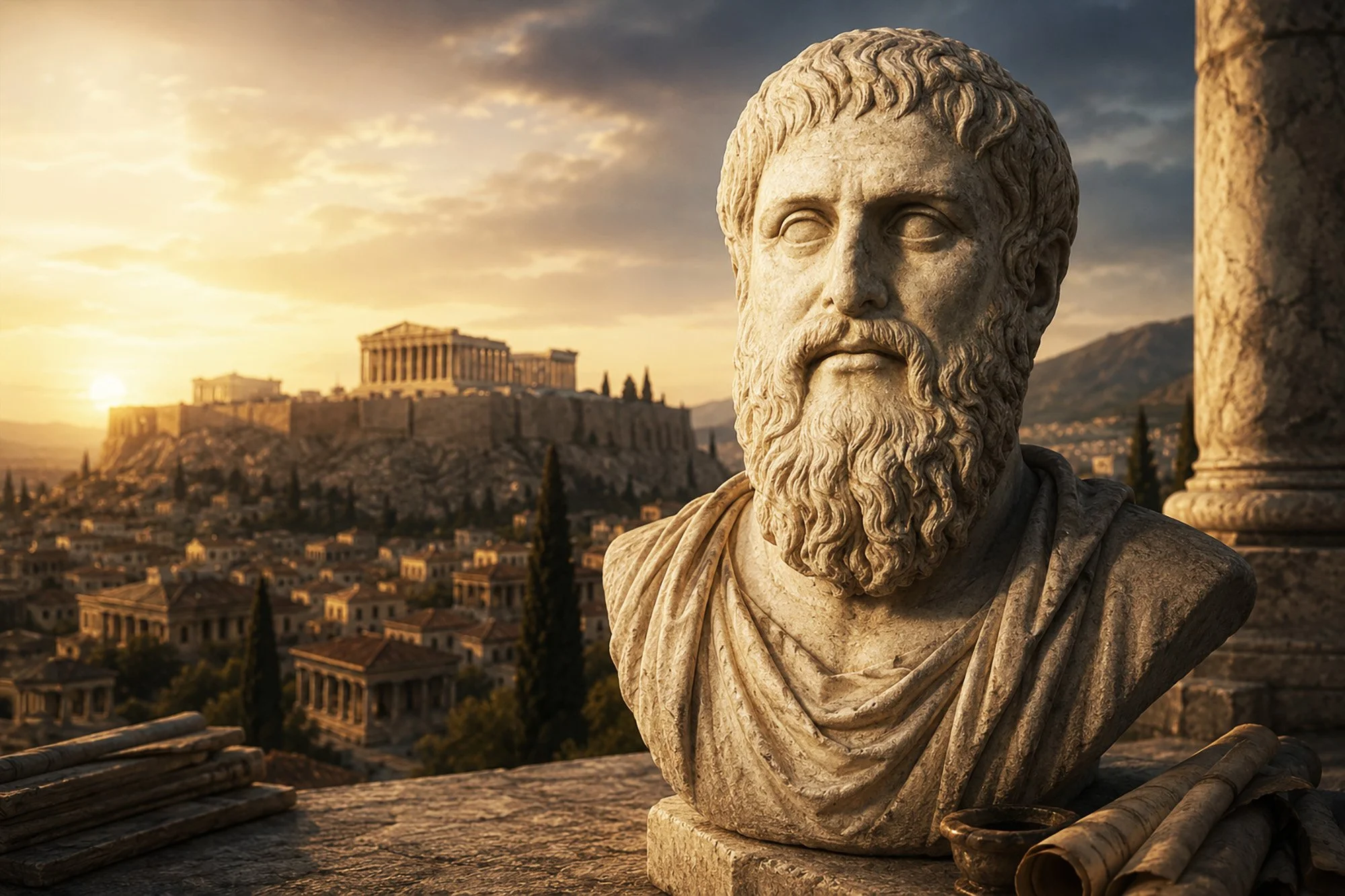
Plato with Athens in the background. Image created with AI.
More than 2,400 years ago, in the streets of ancient Athens, a philosopher began asking questions that still echo across Europe today.
Why do democracies become unstable?
Why do crowds sometimes choose leaders who damage the society they lead?
And what happens when emotion, propaganda and short-term thinking become more powerful than wisdom?
The philosopher was Plato, and his answer became one of the most influential books in European history: The Republic.
Plato did not write during a golden age of calm and stability. Athens was deeply divided. Wars had exhausted the city. Political factions fought each other constantly. Public debate was often loud, emotional and manipulative. The democracy that Athenians were proud of had also condemned Plato’s teacher, Socrates, to death.
To Plato, this was not simply a political mistake. It was evidence that a society without wisdom could become dangerous — even when it called itself democratic.
His solution was radical. He imagined an “ideal state” ruled not by wealthy elites, military strongmen or popular politicians, but by philosopher-kings: leaders trained to seek truth, justice and self-control rather than personal power.
Today, the idea sounds both fascinating and unsettling.
Plato believed that most societies fail because people are too easily distracted by wealth, ambition, fear and desire. He divided society into three groups: rulers, defenders and producers. Justice, he argued, existed when each group fulfilled its role in harmony. Education was central to this system. A good society could only exist if citizens were shaped by good education, moral discipline and a shared sense of responsibility.
Some of Plato’s ideas now feel deeply uncomfortable. He wanted strict control over culture and education. He distrusted democracy. His ideal society left little room for individual freedom. Critics later accused him of imagining a rigid and even authoritarian state.
And yet, many of his questions feel strangely modern.
Across Europe today, people worry about political polarisation, misinformation, populism and the growing distrust of institutions. Social media often rewards outrage more than wisdom. Public debate can feel increasingly emotional and fragmented. At the same time, many societies place enormous faith in experts, technocrats and even artificial intelligence to manage complex problems.
In a way, the old Platonic question has quietly returned:
Can a democracy survive if knowledge and wisdom lose authority?
One of the most famous parts of The Republic is Plato’s Allegory of the Cave. Prisoners sit inside a cave watching shadows projected onto a wall, believing those shadows are reality itself. Only when one prisoner escapes does he discover the larger world outside.
For centuries, Europeans have returned to this image whenever societies seemed trapped by illusion, propaganda or collective fear. In the age of algorithms, viral misinformation and AI-generated realities, Plato’s cave suddenly feels less like ancient philosophy and more like a mirror.
Perhaps Plato’s real importance today is not that he offered the perfect political system. He did not. Even he later admitted that his ideal state was probably impossible.
What remains powerful is the warning beneath it:
A society cannot remain free and stable if truth, education and moral responsibility no longer matter.
Further Reading
The Republic — Plato
The Open Society and Its Enemies — Karl Popper
A History of Western Political Thought — J. S. McClelland