
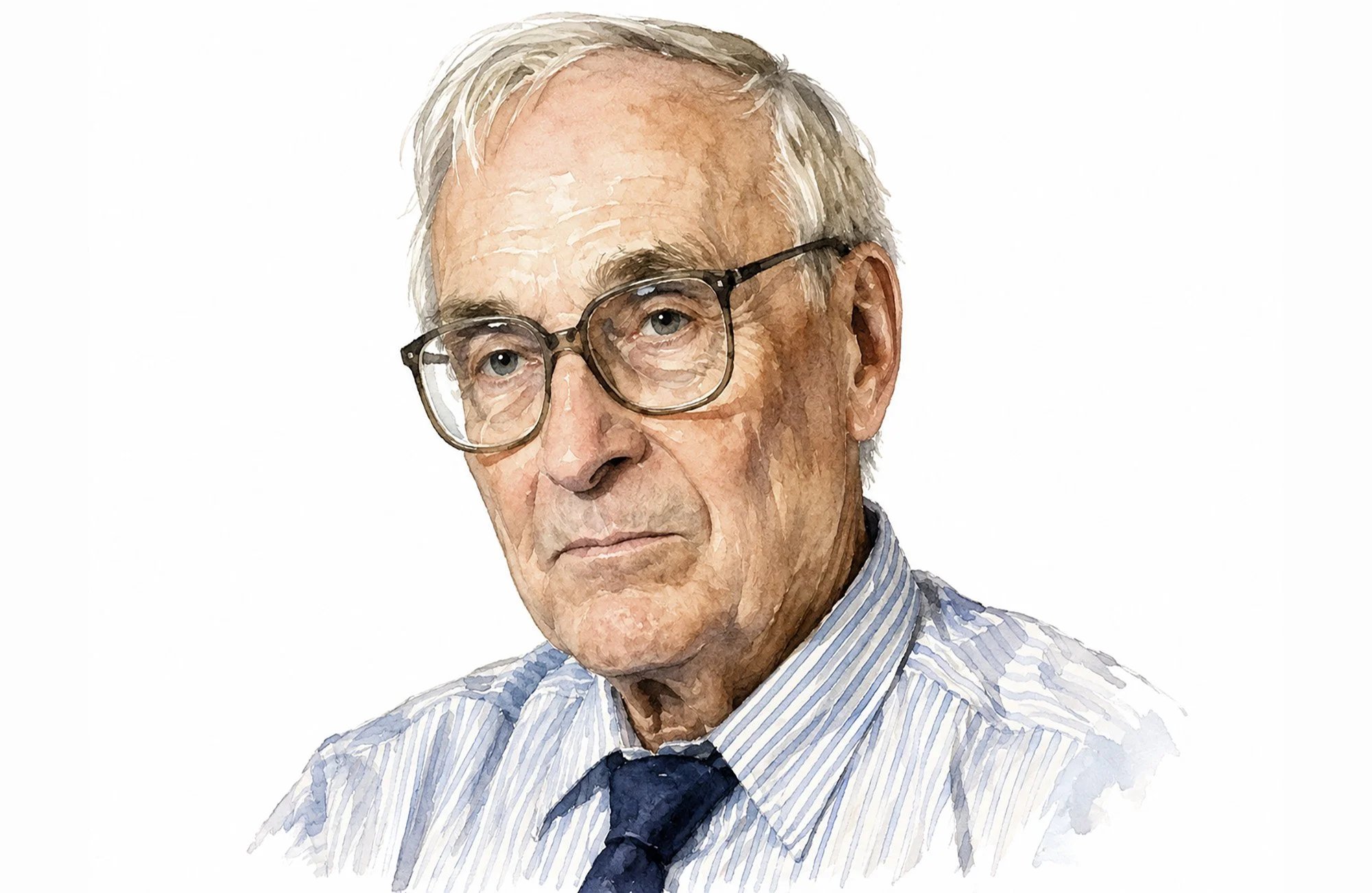
William R. Catton Jr. (1926–2015), whose was one of the first exploring the ecological limits of human expansion in his book Overshoot (1980).
Few books become more relevant with age. Most are products of their time, shaped by the concerns and assumptions of the era in which they were written. William Catton's Overshoot, first published in 1980, seems to have followed a different path. For decades it remained largely unknown outside environmental circles. Today, however, it reads less like a historical document and more like a guide to some of the questions that increasingly dominate public debate.
Catton was a sociologist, but he approached society with the eyes of an ecologist. While most discussions about the future focused on economics, politics, or technology, he asked a simpler question: what happens when a species grows beyond the long-term capacity of its environment? Ecologists had long applied this idea to deer, fish, insects, or bacteria. Catton argued that humans should not assume they are exempt.
More than forty years later, the question feels surprisingly contemporary.
An Age of Abundance
The key to Catton's argument was energy. For most of human history, people lived on the annual income provided by nature: crops, forests, animal power, wind, and water. The amount of energy available each year was limited by what the Earth could produce during that year.
The industrial age changed that.
Coal, oil, and natural gas gave humanity access to enormous stores of energy accumulated over millions of years. Catton described these resources as a kind of inheritance: wealth stored by nature long before humans arrived. Combined with technological innovation, they transformed agriculture, transportation, industry, and medicine. Populations expanded. Cities grew. Standards of living rose. Economic growth became so familiar that many people came to regard it as the normal state of affairs.
The scale of this transformation is difficult to overstate. A modern farmer using machinery and synthetic fertilizers can produce food for hundreds of people. Goods can be transported across continents within days. Vast cities can exist in deserts because fossil fuels allow water to be pumped, treated, and distributed. Industrial civilization became possible because humanity gained access to a temporary windfall of concentrated energy.
The problem, Catton argued, was not the windfall itself. The problem was what happened next.
Living on Inheritance
Imagine a family that spends its savings as if it were income.
At first, everything appears to be going well. The house improves, the meals become richer, and life feels more prosperous every year. Looking around, it seems obvious that the family has discovered a successful formula.
Only later does an uncomfortable reality emerge. The money being spent is not income. It is capital. Once it is gone, it is gone.
Catton believed industrial civilization had made a similar mistake.
The graph accompanying this article illustrates the idea. The upper dashed line represents what Catton called phantom carrying capacity: a temporary increase in the Earth's ability to support human populations and consumption, created by fossil fuels, technology, and the exploitation of accumulated natural wealth.
The lower line represents long-term carrying capacity: what the Earth can support indefinitely without drawing down its natural capital.
For a time, the two seem almost indistinguishable. The temporary abundance provided by fossil fuels makes extraordinary growth possible. Humanity expands into a space that appears sustainable because the underlying resources are still plentiful.
But appearances can be deceiving.
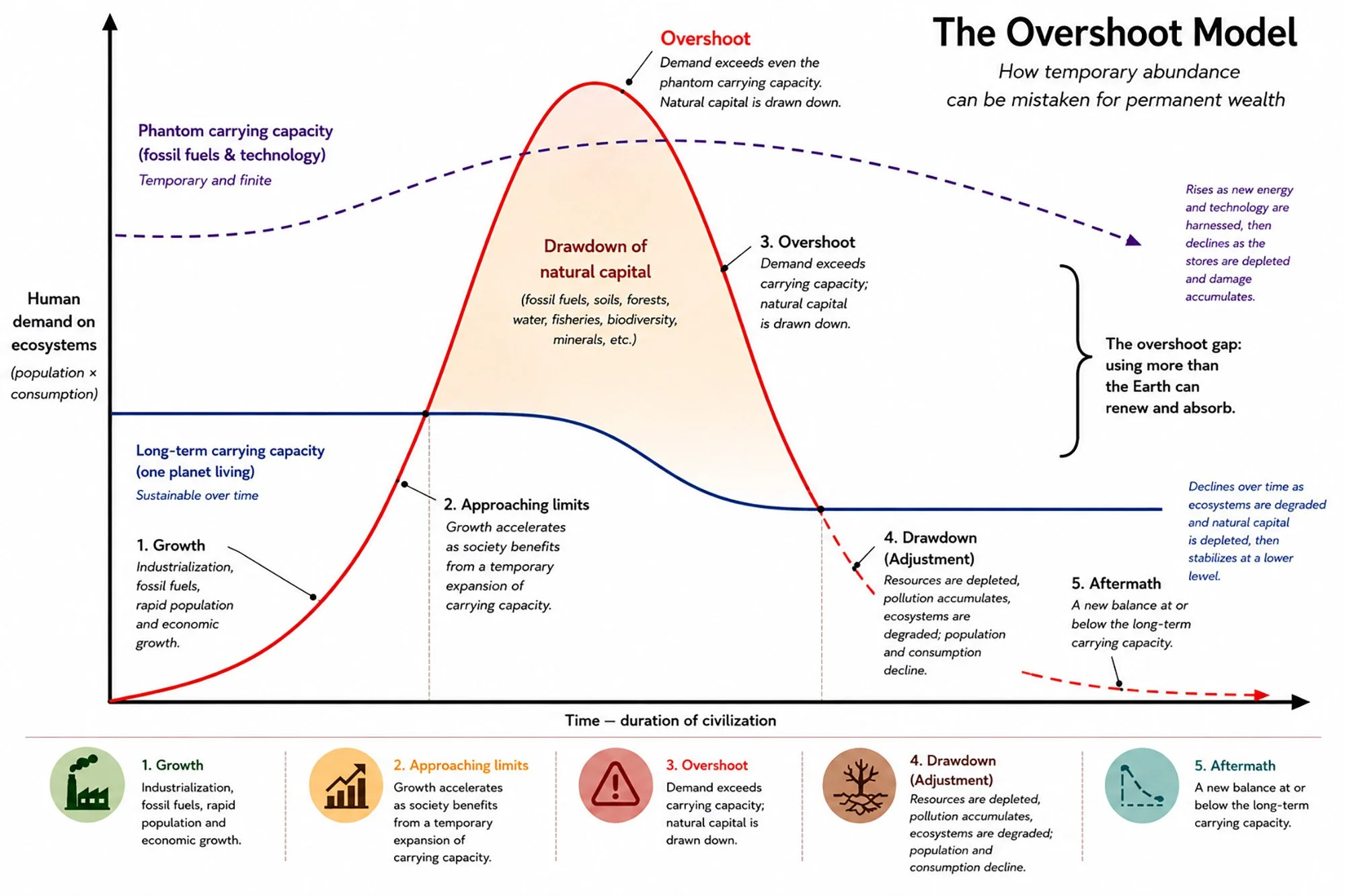
Catton's overshoot model: fossil fuels and other forms of natural capital temporarily expand carrying capacity, enabling rapid growth. But as that inheritance is consumed, both prosperity and the Earth's ability to support it come under pressure.
The Overshoot Phase
The red curve in the graph represents human demand on ecosystems.
As long as demand remains below carrying capacity, growth can continue without fundamentally damaging the resource base. Problems arise when demand exceeds what the Earth can renew and absorb.
This is the point Catton called overshoot.
Most environmental debates focus on individual symptoms: climate change, biodiversity loss, groundwater depletion, soil erosion, declining fisheries, or pollution. Catton encouraged readers to see these not as separate crises but as different expressions of the same underlying process.
During overshoot, society begins drawing down natural capital.
Forests are harvested faster than they regrow. Aquifers are depleted faster than they refill. Fertile soils erode. Fisheries decline. Fossil fuels are burned. The inheritance is converted into current prosperity.
For a while, this may even accelerate growth. The easiest and richest resources are usually exploited first. Living standards rise. Economic indicators improve. Success reinforces the belief that growth can continue indefinitely.
Yet the apparent prosperity contains a hidden contradiction. The more completely society succeeds in converting natural capital into economic activity, the more it reduces the foundations on which future prosperity depends.
The shaded area beneath the peak of the curve represents this drawdown of natural capital.
It is the heart of Catton's argument.
When the Limits Move
One of the most interesting features of the graph is that neither carrying-capacity line remains fixed.
The temporary carrying capacity created by fossil fuels and technology eventually begins to decline. The richest resources are depleted first. Remaining reserves become harder and more expensive to extract. More energy and effort are required simply to maintain existing systems.
But the lower line also changes.
For much of the growth phase, the Earth's long-term carrying capacity remains relatively stable. Then, as overshoot continues, it begins to decline as well. Degraded soils produce less food. Damaged ecosystems become less resilient. Biodiversity shrinks. Freshwater resources become more difficult to access.
The result is a troubling feedback loop. Humanity is not only exhausting a temporary bonus; it may also be reducing the productive capacity that would remain after the bonus is gone.
This distinction is crucial. Overshoot does not merely consume resources. It can alter the conditions under which future generations must live.
In ecological terms, the carrying capacity itself becomes a moving target.
Adjustment
No species can indefinitely consume resources faster than they are renewed.
Eventually reality reasserts itself.
Catton referred to this stage as adjustment. He was cautious about predicting exactly how it would occur. Different societies may respond in different ways. Technological innovation can delay certain limits. Cultural adaptation can reduce pressure on resources. Demographic change may alter patterns of demand.
Yet none of these possibilities eliminate the underlying ecological principle.
If demand exceeds carrying capacity long enough, some form of correction becomes unavoidable.
The shape of that correction is impossible to know in advance. History offers examples ranging from gradual decline to sudden collapse. Catton's concern was not to predict a specific future but to highlight a pattern that had appeared repeatedly in both human and natural systems.
Growth beyond limits eventually encounters consequences.
Income and Capital
What makes Overshoot such a remarkable book is that it shifts the discussion away from politics and ideology and toward a more fundamental question.
Are we living from income, or are we living from capital?
The distinction sounds technical, but it reaches into almost every contemporary debate. Climate change, biodiversity loss, declining fisheries, groundwater depletion, soil degradation, and resource scarcity can all be viewed through this lens.
A society living from income relies on flows that can be renewed year after year. A society living from capital consumes stocks that accumulated over long periods of time.
Catton's warning was not that humanity would inevitably collapse. It was that industrial civilization had become so accustomed to living from accumulated capital that many people no longer recognized the difference.
The graph is therefore not a prophecy. It is a reminder.
Temporary abundance can be mistaken for permanent wealth. Growth can disguise depletion. Prosperity can conceal dependence on resources that are quietly disappearing beneath the surface.
More than four decades after its publication, Overshoot remains compelling because it invites readers to look beyond immediate events and ask a deeper question: not how much wealth we are creating today, but what we are spending in order to create it.
That question may be even more relevant now than it was in 1980.
Further Reading
William R. Catton Jr., Overshoot: The Ecological Basis of Revolutionary Change (1980)
William R. Catton Jr., Bottleneck: Humanity's Impending Impasse (2009)