
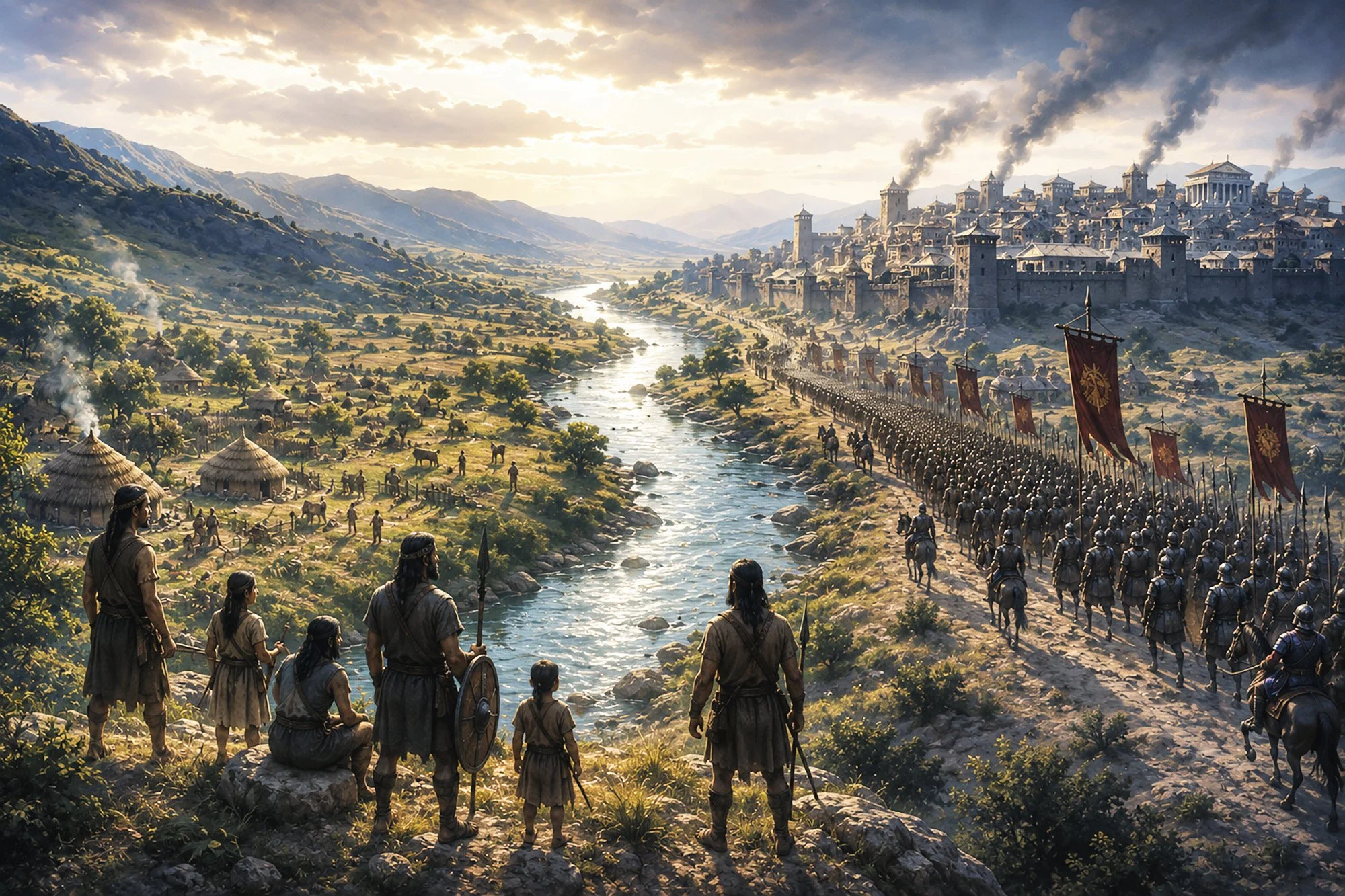
Image created with AI.
In 1984, Andrew Bard Schmookler published a remarkable book called The Parable of the Tribes. It explores a simple but important question: if most people prefer peace, why has so much of human history been shaped by war, conquest, and competition?
Schmookler begins with a thought experiment. Imagine several tribes living near one another. If all choose peace, they can coexist peacefully. But what happens if just one tribe decides to expand its territory and dominate its neighbours?
The other tribes face a difficult choice. They can be conquered, flee, submit, or prepare to defend themselves. Yet successful defence often requires them to become more organised, more militarised, and more focused on power. In trying to resist the aggressor, they begin to resemble it.
This is the central insight of the book. Power does not spread because everyone wants it. It spreads because those who refuse to compete with powerful rivals are often overwhelmed by those who do.
For Schmookler, this is more than an explanation for war. It is a theory of history. He argues that once societies began competing with one another, a process of selection took hold. Societies that became better at organising power were more likely to survive, expand, and leave their mark on the future. Over centuries, this helped shape kingdoms, empires, armies, bureaucracies, and many of the institutions we associate with civilisation.
Viewed in this way, history is not simply a story of ambitious rulers and military victories. It is also a story of systems. Even communities that preferred a peaceful path could find themselves drawn into the struggle because their neighbours were playing by different rules.
Schmookler does not argue that human beings are naturally violent. Rather, he suggests that the circumstances in which societies find themselves can be as important as their intentions. A society may choose peace, but it cannot choose peace on behalf of its neighbours.
The book remains controversial. Critics point out that human history has been shaped not only by competition but also by trade, cooperation, religion, migration, and cultural exchange. Others question whether early hunter-gatherer societies were as peaceful and egalitarian as Schmookler suggests. Civilisation, they argue, cannot be explained by the pursuit of power alone.
Yet even those who disagree with some of his conclusions often acknowledge the strength of the question he raises. What happens when a single society chooses expansion in a world where its neighbours would rather live in peace? Schmookler's answer is that the consequences spread far beyond the original aggressor, shaping the entire system around it.
More than forty years after its publication, The Parable of the Tribes remains a fascinating lens through which to view the past. Whether one accepts its conclusions or not, it encourages us to look beyond individual leaders and battles and to ask a deeper question: how much of human history has been shaped not by what people wanted, but by the situations they could not avoid?