trier

Trier's Dom and the Liebfrauenkirche

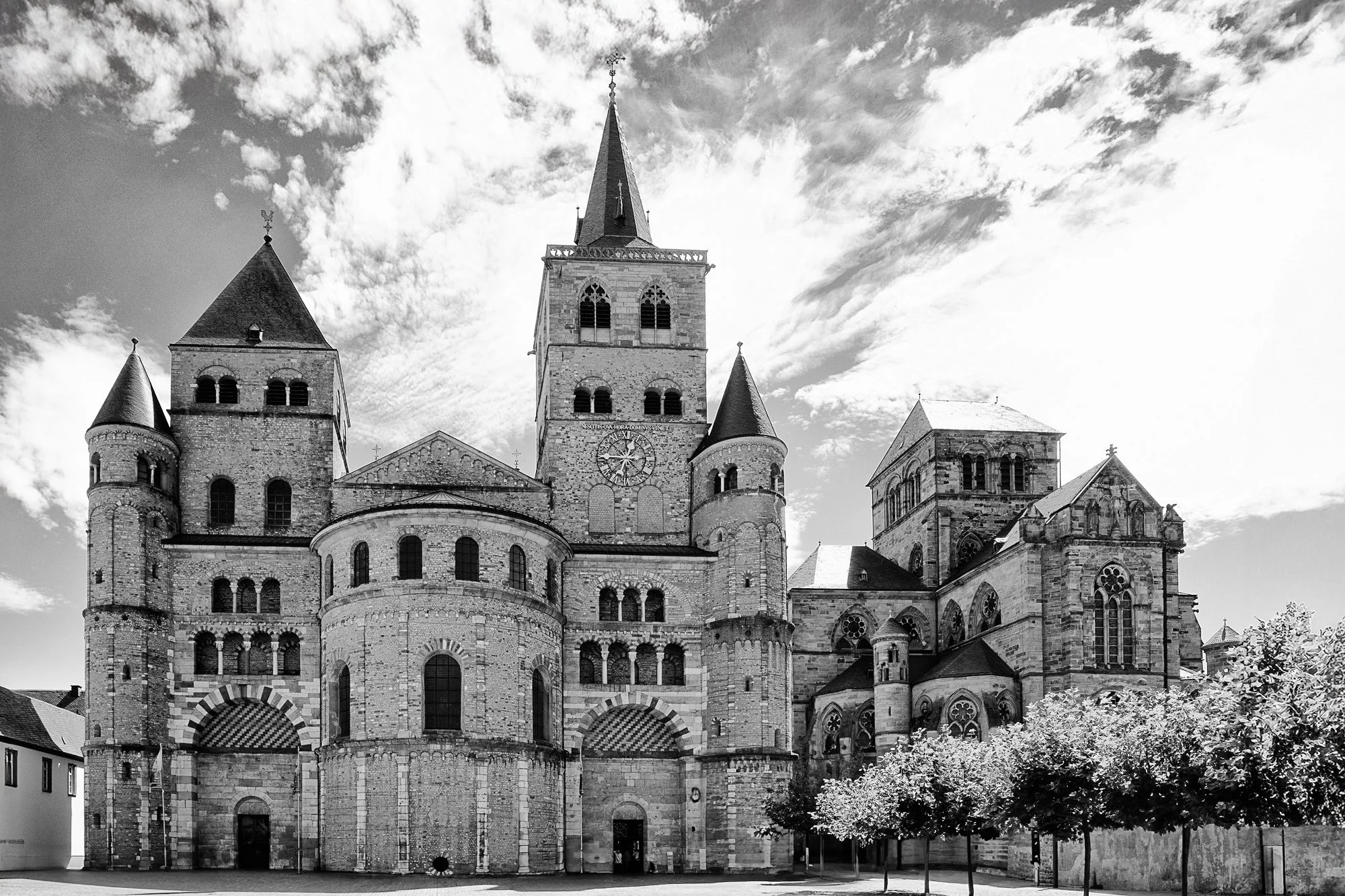
Trier’s Dom (left) and the Liebfrauenkirche (right).

Stand on the Domfreihof, squarely before the west front of Trier’s cathedral. The stones give off that old, cool breath. Bells roll somewhere above the roofs. In this one view—Dom St. Peter straight ahead, Liebfrauenkirche just to the right—the city’s whole timeline seems to unspool.

The Dom: Rome Repurposed, Empire Remembered

Beneath the Romanesque towers runs a core of 4th-century masonry: a Constantinian church complex raised after Christianity’s legalization. Trier—Augusta Treverorum, founded as a Roman city around 16 BCE—became an imperial residence in the early 300s; Constantine and his court were here c. 306–316. Around c. 326–330, palace ground and Roman brick were folded into a monumental double church. You’re looking at that antique skeleton wrapped in later skin.

The rebuilds came in waves. 10th–12th centuries: Ottonian and Romanesque campaigns thickened the westwork and towers, giving the façade its fortress calm. 13th century: Gothic openings at the east drew more light into the choir. Late 17th–18th centuries: Baroque furnishings softened the interior. 1944 air raids cracked vaults; post-1945 restorations pared the space back to clarity.

The cathedral also reads like a ledger of power. By 1356, the Archbishop of Trier stood among the empire’s seven prince-electors under the Golden Bull, choosing kings of the Romans. From chancery to mint, from market tolls to monasteries, the cathedral chapter worked within government as much as alongside it. And devotion ran on its own clock: pilgrim surges for the Heiliger Rock (Holy Tunic) mark dates across the centuries—1512, 1844, 1891, 1933, 1959, 1996, 2012—each season swelling the square you’re standing in.
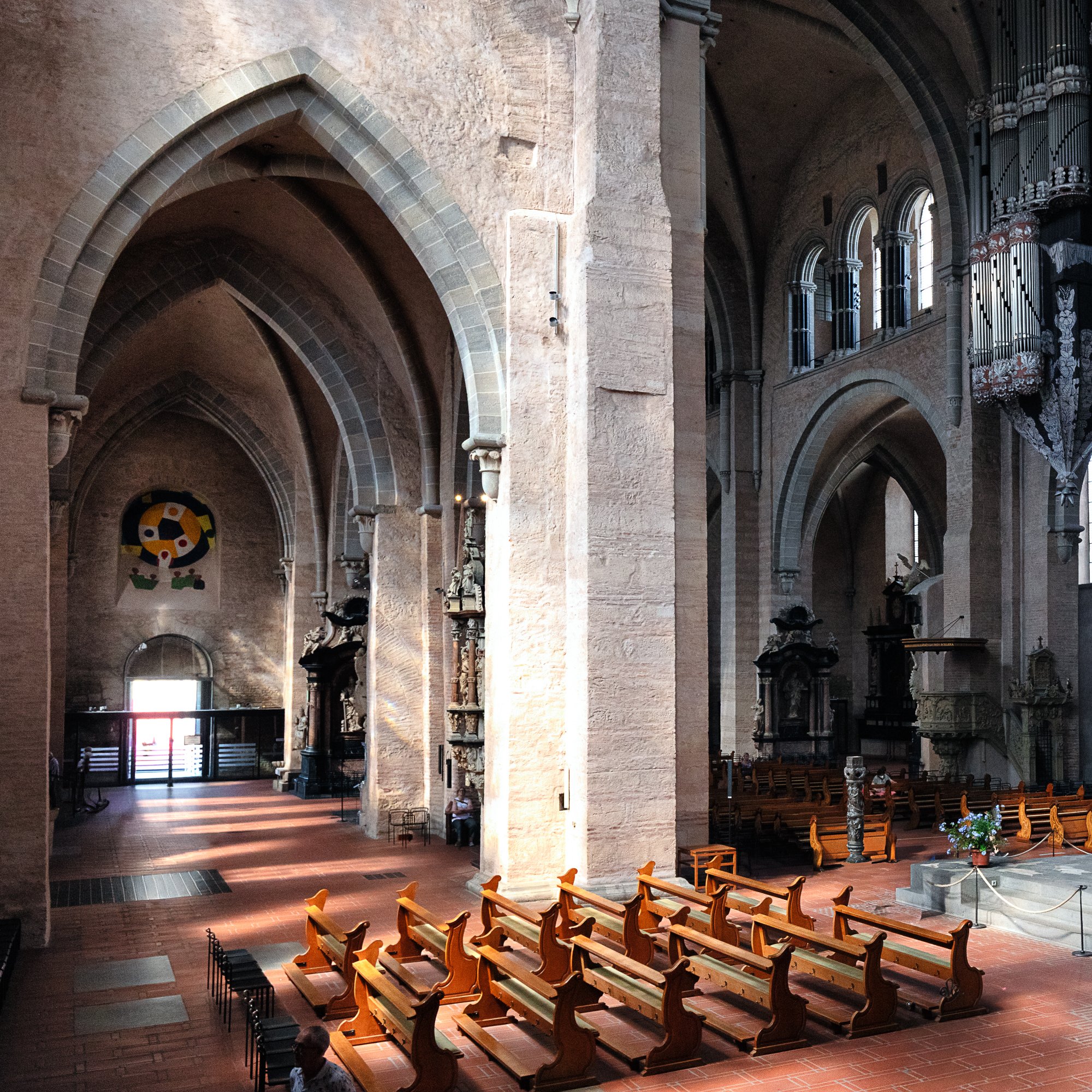
The interior of Trier’s Dom.

The Liebfrauenkirche: A Rose of Early Gothic

Glance right and the mood changes. Where the Dom plants its feet, Liebfrauen rises on tiptoe. Built c. 1227–1243 (with finishing work into the 1260s), it is among the earliest pure Gothic churches in Germany. Its plan—an interlaced cross inscribed in a circle—unfurls like a stone flower. Twelve main supports ring the center: apostles, months, tribes, the ordered cosmos in geometry. Tracery and pointed arches turn stone into lace; the portal frames shadow rather than mass. If the Dom is Rome baptized, Liebfrauen is France translated—Gothic ideas traveling the Moselle in the early 1200s and settling into local craft.
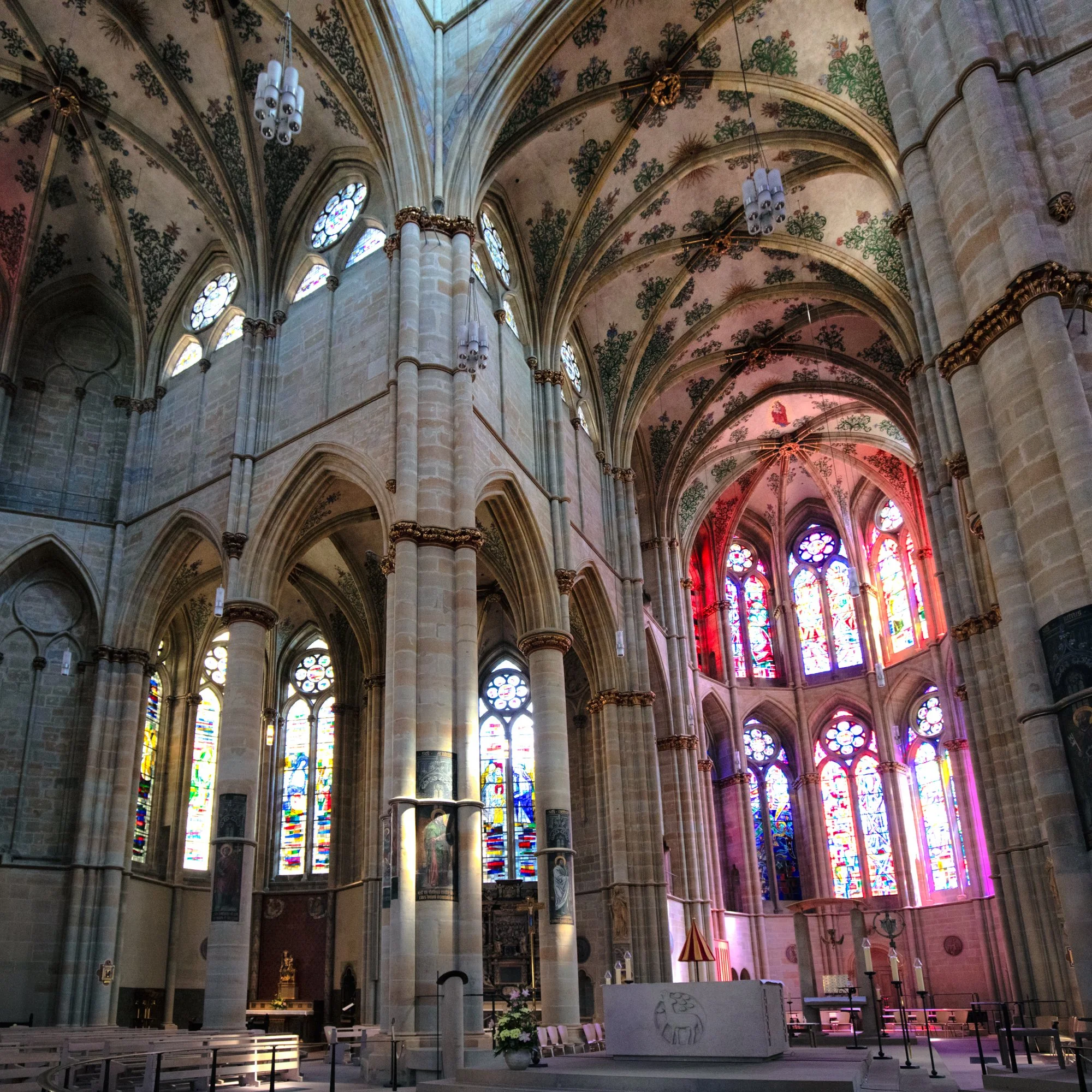
The interior of the Liebfrauenkirche.

One Square, Many Ages

From this spot you can pace the centuries with your eyes. The Dom’s antique core (c. 330) meets its medieval armor (1000s–1200s); Liebfrauen’s airy leap (1230s) stands almost shoulder-to-shoulder. Behind the façades lies a city that has practiced continuity: the Aula Palatina (Constantine’s throne hall, c. 310), the Imperial Baths (4th century), the Porta Nigra (c. 180–200). Power shifted—from emperors to bishops to electors to citizens—but the thread held.

War shook both churches; scaffolds grew like forests. When the dust of the 1940s settled, careful restorations returned them to the rhythm of daily use. The square filled again with processions and choirs; tourists folded into pews; a baptismal font caught candlelight as it had six hundred years earlier.

Reading the Façades from Left to Right

Let your gaze travel across the Dom’s west front: layered portals, blind arcades, the disciplined stacking of volumes—architecture meant to hold a crowd’s attention on a feast day. Slide to the right and the rhythm quickens. Liebfrauen’s tracery reads like script on vellum; its buttresses pull the eye upward; its plan—circle, cross, petals—seems to turn even while it stands still. Two voices, one conversation: memory and ascent, weight and light.

The Present Tense of Old Stones

In 1986, UNESCO folded these churches into the World Heritage listing “Roman Monuments, Cathedral of St. Peter and Church of Our Lady in Trier.” That inscription didn’t freeze them in amber; it simply named what you feel on the square. The Dom’s Roman bones and medieval muscle, Liebfrauen’s early Gothic inventiveness, the Roman city still breathing all around—each has taken its turn leading. They still do. Stand here long enough, and the bell that calls the hour will sound like a page turning.
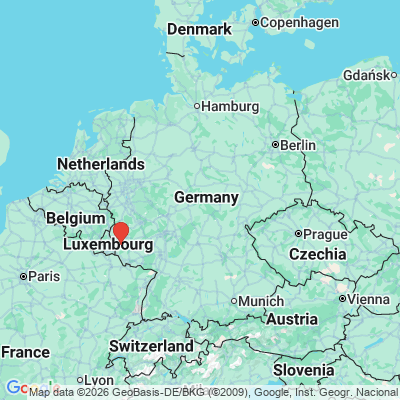
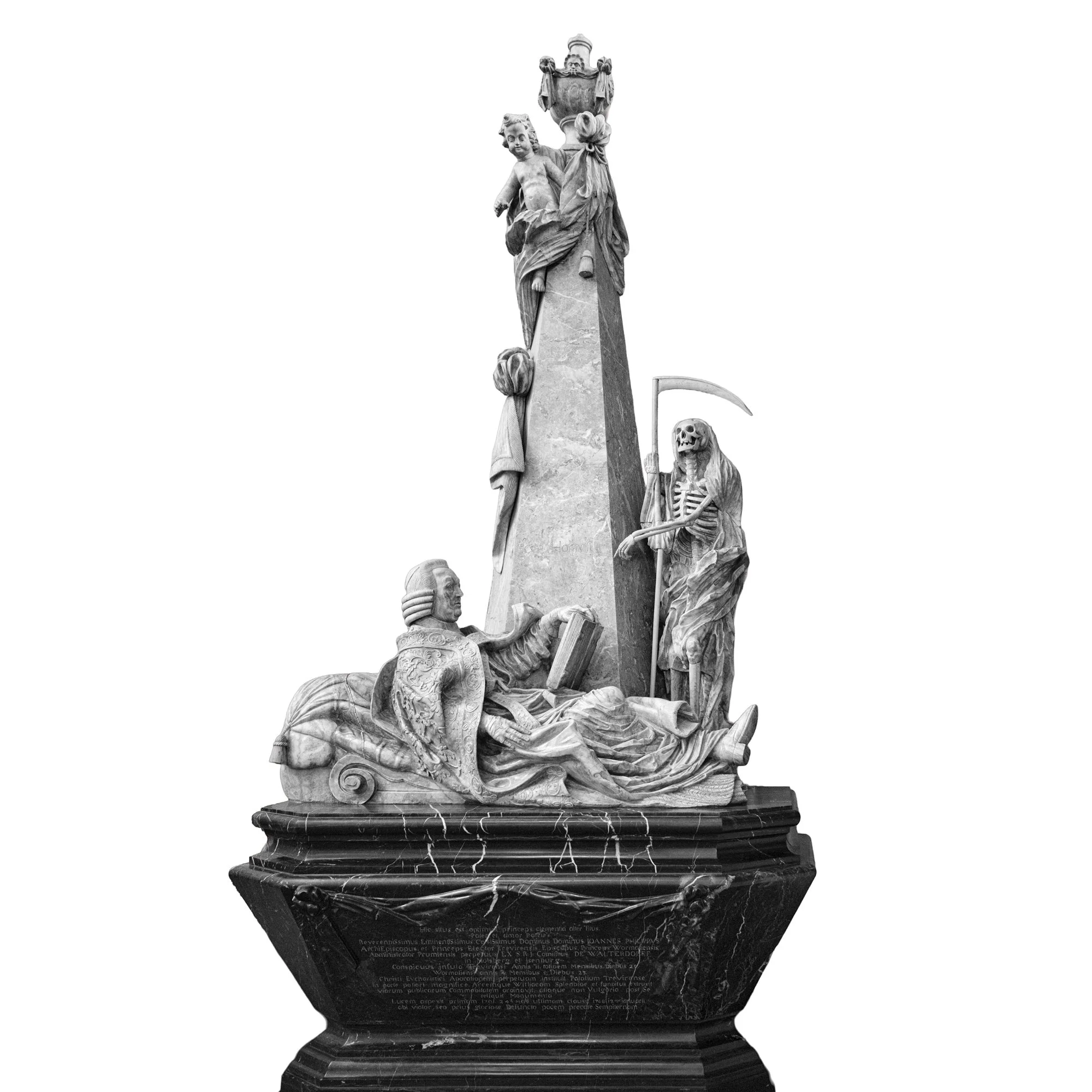
The Gentle 18th Century Prince of Trier – Johann Philipp von Walderdorff

The baroque tomb monument of Archbishop Johann Philipp von Walderdorff in Trier Cathedral — the prince lies serenely before Death itself, while angels above lift his soul toward eternity.

In the quiet side aisle of Trier Cathedral, beneath a swirl of baroque marble, lies a prince who once ruled not by fear or fire, but by grace. The inscription calls him “clementia alter Titus” — “in his mercy, another Titus.” His name was Johann Philipp von Walderdorff, Prince-Elector and Archbishop of Trier, Bishop of Worms, and perpetual Administrator of Prüm. He lived in a world where the Rhine was both a frontier and a lifeline, a corridor of faith and power running from Cologne to Mainz and beyond.

The 18th century was the twilight of the prince-bishops — those curious rulers who combined mitre and sceptre, and who governed both souls and streets. In the Rhineland, their territories were dotted with vineyards, abbeys, and the great palaces that embodied their dual authority. Among them, Walderdorff stood out as a man of refinement and quiet ambition. Born in 1701 into an old noble family, he rose through the church ranks to become Trier’s Elector in 1756, one of the seven men entitled to choose the Holy Roman Emperor. Yet his legacy was not in politics or war, but in the enduring beauty he left behind.

Walderdorff commissioned the lavish Kurfürstliches Palais beside Trier’s Roman basilica — a masterpiece of Rococo elegance where angels and cherubs play among stuccoed vines. He rebuilt the castle at Wittlich, improved the public roads of his domain, and founded the perpetual adoration of the Eucharist in Trier’s cathedral. His reign was gentle, prosperous, and deeply rooted in the artistic flowering of the late baroque — an age when faith still expressed itself through splendor.

When he died in 1768, his body was laid to rest in the very cathedral he had adorned. His monument speaks the language of the era: black marble veined with white, golden letters glowing under candlelight, and above it the sculpted figure of the serene prelate himself. To those who pass by, it is more than a grave — it is a reminder of a time when the Rhine valley was a patchwork of princely bishoprics, each with its own court, orchestra, and chapel, each ruled by men who saw no divide between holiness and beauty.

Walderdorff’s world would soon vanish. Within a generation, the French Revolution and Napoleon swept away the ecclesiastical states that had shaped the region for a millennium. Yet in Trier, among the stones that remember Rome and the saints who followed, his marble tomb still glows softly — a relic of an age when mercy and art walked hand in hand.

Further Reading

  • The Electorate of Trier and the Prince-Bishops of the Rhine – A cultural history of ecclesiastical states in the Holy Roman Empire.

  • The Rococo in the Rhineland – Architecture and patronage under the prince-archbishops of Trier.

  • Trier Cathedral: From Constantine to the Baroque – A study of the cathedral’s evolving role in European history.

Porta Nigra, Trier (Germany)

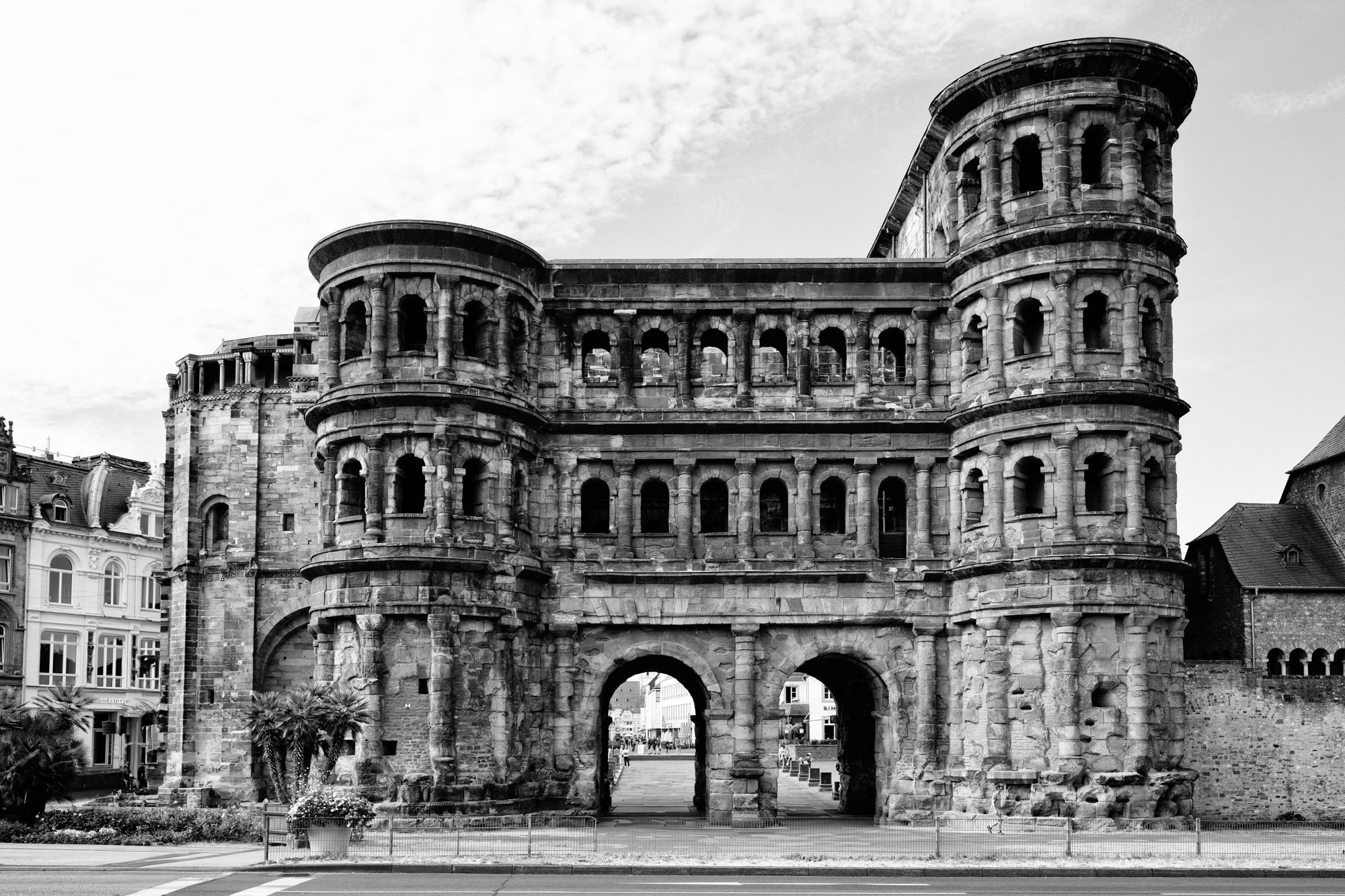
Porta Nigra, Trier.

The Porta Nigra, located in Trier, Germany, stands as a testament to the city's rich history and Roman legacy. Built between 186 and 200 AD during the reign of Emperor Marcus Aurelius, it served as one of the four city gates of ancient Augusta Treverorum, the Roman name for Trier.

Originally named Porta Martis, meaning "Gate of Mars," the Porta Nigra was constructed using large sandstone blocks without mortar, a technique characteristic of Roman architecture. Its name was changed to Porta Nigra, or "Black Gate," in the Middle Ages due to the darkened color of its stone over time.

Throughout its existence, the Porta Nigra has witnessed significant events. In the 5th century, Trier fell under Frankish rule, and the gate was converted into a church dedicated to Saint Simeon. During this time, its distinctive upper stories were added, transforming it into a basilica.

In subsequent centuries, the Porta Nigra underwent further transformations. It served as a fortress, a monastery, and a barracks. However, by the 11th century, it had fallen into disuse and was gradually buried by layers of soil and debris.

In the 19th century, the Prussian government undertook efforts to restore the Porta Nigra to its former glory. The surrounding structures were demolished, and the gate was uncovered and meticulously restored to its original Roman appearance.

Today, the Porta Nigra stands as an iconic symbol of Trier's Roman past and is recognized as a UNESCO World Heritage Site. Visitors from around the world marvel at its imposing presence and architectural significance, making it one of the most popular tourist attractions in the region.