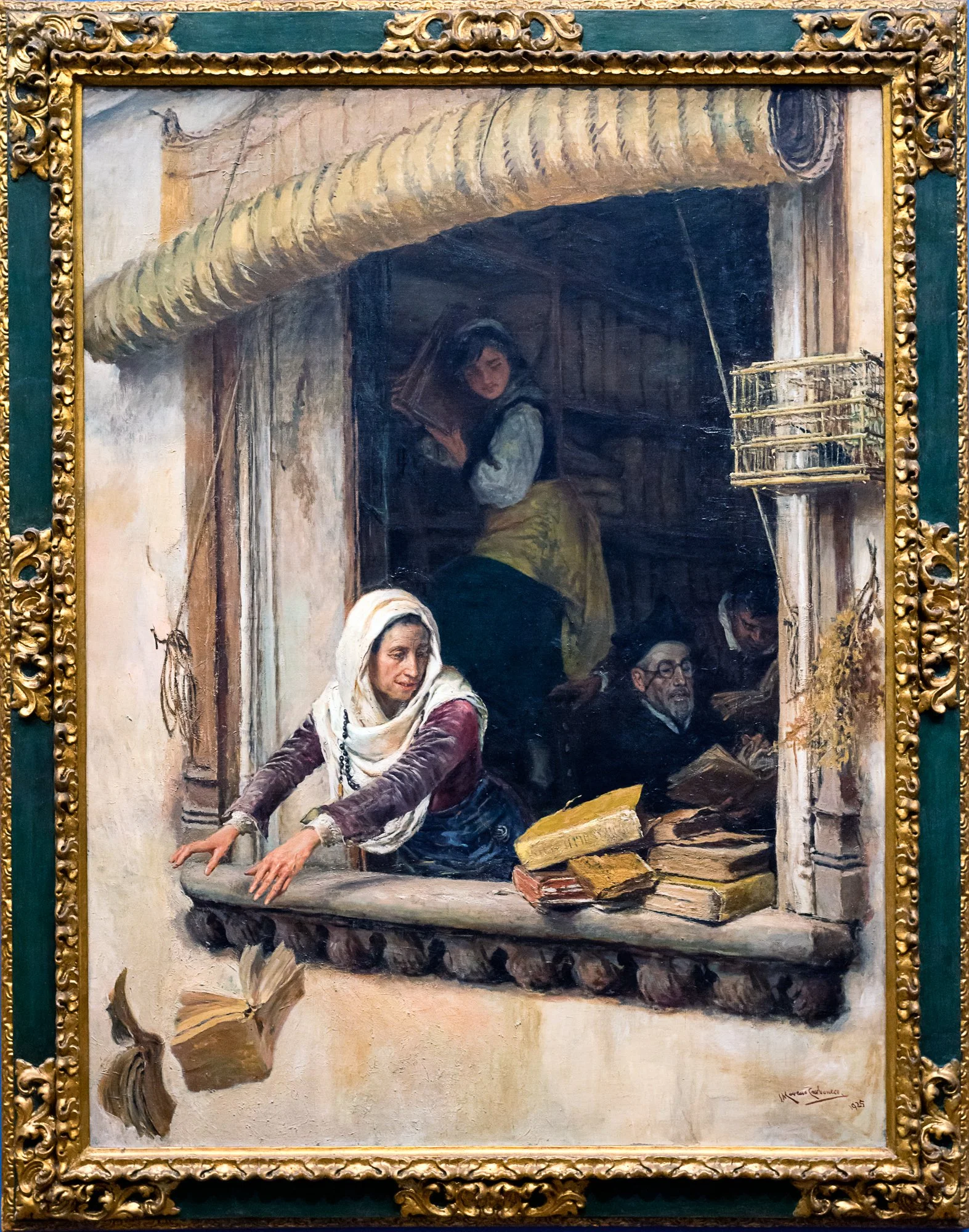
José Moreno Carbonero, El escrutinio (1925), Museo de Málaga – The priest and barber put Don Quixote’s library on trial.
In the Museo de Málaga hangs a painting inspired by one of the most memorable scenes in Spanish literature. The work, “El escrutinio” (“The Scrutiny”), was painted in 1925 by the Malagueño artist José Moreno Carbonero.
The scene comes from Don Quijote de la Mancha by Miguel de Cervantes.
The Painter
José Moreno Carbonero (1860–1942) was one of Spain’s leading historical painters. Born in Málaga, he trained in Madrid and Paris and became known for dramatic scenes from Spanish history. One of his most famous paintings shows the moment Christopher Columbus was received by the Catholic Monarchs after returning from the New World.
Besides historical subjects, he occasionally turned to Spanish literature for inspiration. “El escrutinio” is one such example.
The Scene
In the early chapters of Don Quixote, the aging nobleman Alonso Quijano loses himself in books about knights and chivalry. Convinced that these stories have driven him mad, his friends decide to examine his library.
The village priest and the barber inspect the books one by one—“the scrutiny.” Some are condemned and thrown aside to be burned, while a few are spared. The episode is humorous, but it also allowed Cervantes to poke fun at the popular literature of his time.
Moreno Carbonero captures this moment perfectly: figures gathered around a pile of books, debating their fate.
Seen today in the museum in Málaga, the painting is both a tribute to Cervantes and a reminder of the power of stories. After all, in Don Quixote it is books that inspire a man to reinvent the world—and sometimes even himself.