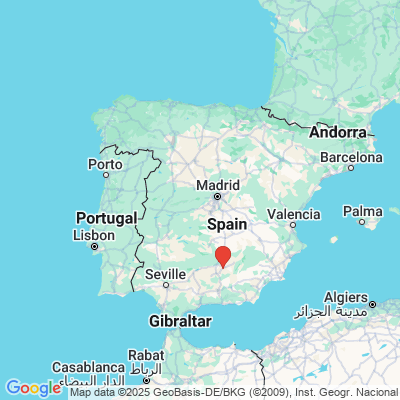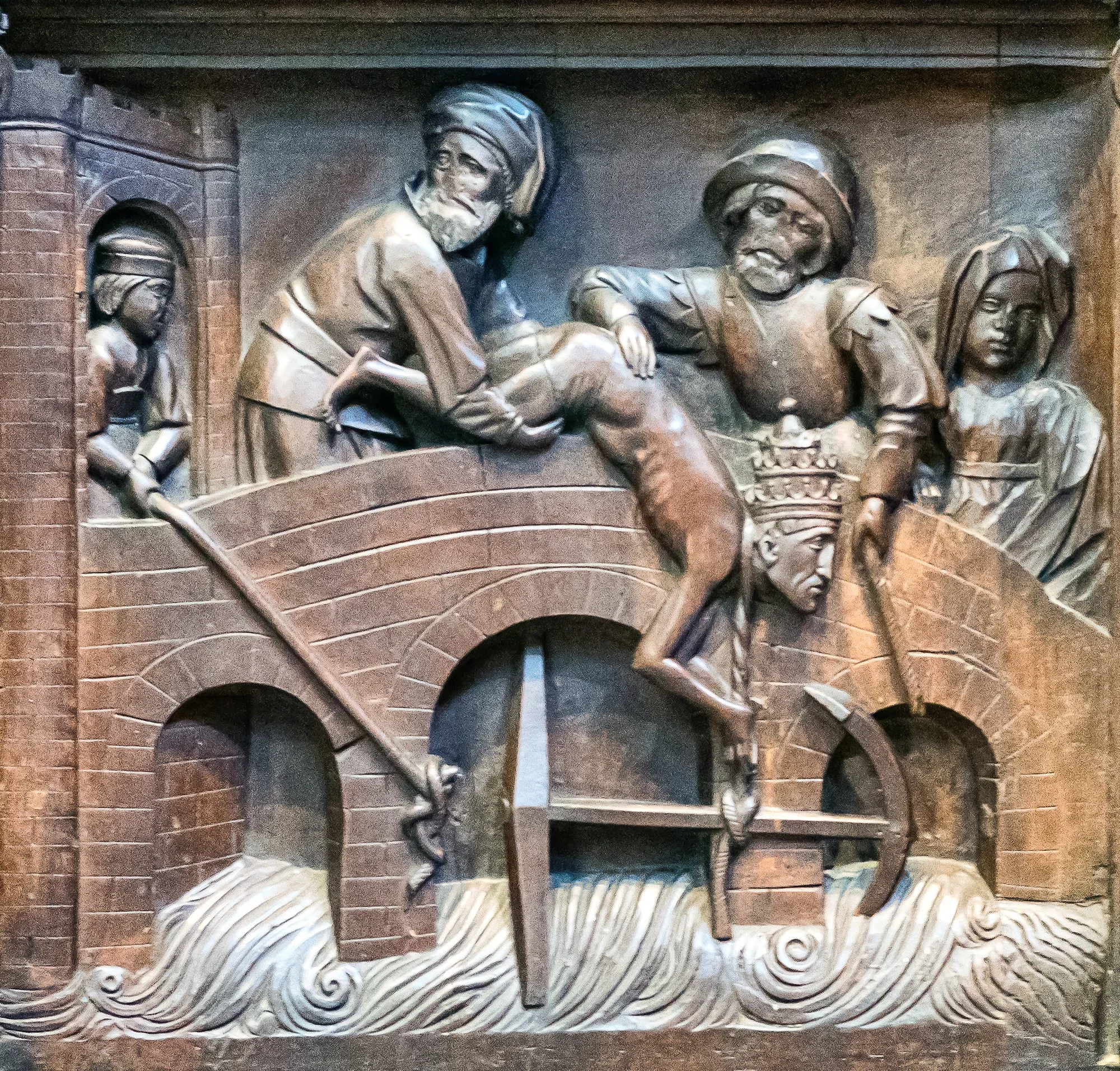
A dramatic detail from the choir stalls of Jaén Cathedral: Pope Clement I is thrown from a bridge with an anchor around his neck, a reference to his martyrdom in the late 1st century after exile to the Crimea on the Black Sea.
Walk into the choir of Jaén Cathedral and your eye is drawn, sooner or later, to a small but striking scene. A man is being forced from a bridge. Around his neck hangs an anchor. Below him, the water churns. The figures pushing him lean forward with effort; there is no hesitation in their movement.
It is a moment frozen in wood—but it tells a story that began almost two thousand years ago. The man is Pope Clement I.
A Leader in the First Century
Clement lived in the late 1st century (around 35–99 AD), at a time when Christianity was still a small and often mistrusted movement within the Roman Empire. He is traditionally regarded as one of the earliest leaders of the Christian community in Rome—often listed as the fourth bishop of Rome, after Saint Peter.
This was not yet a powerful institution. On the contrary, Christians were viewed with suspicion because they refused to participate in Roman religious rituals tied to loyalty to the state. For someone in a visible leadership role, that made life dangerous.
Exile to the Edge of the Empire
According to early Christian tradition, Clement’s influence led to his arrest during the reign of the Roman emperor Trajan (98–117 AD). Instead of being executed in Rome, he was banished to the distant region of the Crimea, on the northern shores of the Black Sea—then a harsh and remote frontier of the empire.
There, he was put to work among prisoners, many of them condemned to forced labour in quarries. Yet exile did not silence him. Clement continued to preach and support those around him, and his presence reportedly strengthened a growing Christian community even in these difficult conditions.
The Anchor and the Sea
For the Roman authorities, this was the opposite of what exile was meant to achieve. Rather than disappearing, Clement had become a source of influence far from Rome.
The response was final. He was condemned to death in a way that would leave no trace. An anchor was tied around his neck, and he was thrown into the sea to drown—most likely sometime toward the end of the 1st century, around 99 AD.
This detail—the anchor—is what fixed his story in memory. It became his unmistakable symbol, allowing people to recognize him in art across Europe, even centuries later.
A Story That Reached Jaén
The carving in Jaén is part of that long journey. By the time these choir stalls were created, likely in the early modern period, the story of Clement had become part of a shared visual language across Catholic Europe. Artists did not need to explain it. A man, an anchor, and water were enough.
Even today, without knowing the name, the scene remains powerful. It shows a moment of force and finality—but also something else: the attempt to silence a voice by removing it completely.
Yet the story endured. From Rome to the Crimea, and from there across Europe to places like Jaén, it survived not just in texts, but in images—quietly carved, waiting to be understood.