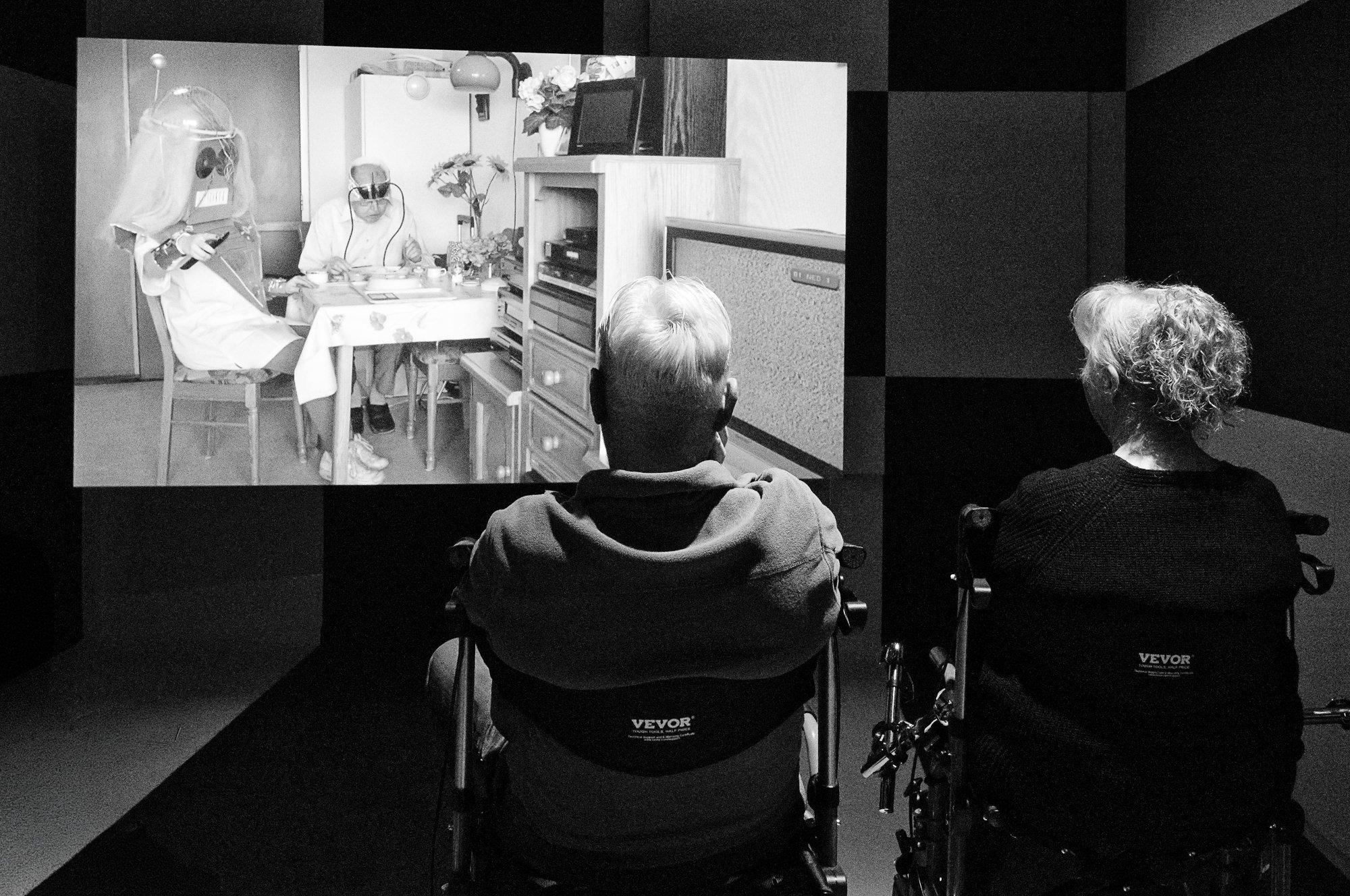
Visitors watching Progress vs Regress (2016) by the Dutch artist Melanie Bonajo.
I saw this movie at the Museum van Bommel van Dam in Venlo (The Netherlands). It is Progress vs Regress (2016) by the Dutch artist Melanie Bonajo.
The movie begins with a simple idea: instead of asking what progress means in theory, ask the people who have actually lived through it.
Bonajo gives the floor to people in their eighties and nineties. They speak about changes that shaped their lives—women’s suffrage, the contraceptive pill, television, the car. Things we now take for granted once redefined what freedom meant. Some of these changes clearly expanded their world.
But the tone shifts when the conversation moves to the present. The internet, smartphones, constant connectivity—these are not simply improvements. They make communication easier, but can also create distance. The world feels faster, more efficient, but not always more human.
What makes the movie compelling is its calm honesty. There is no grand argument, no dramatic conclusion. Just people reflecting on what has been gained—and what may have been lost.
In the second half, younger and older generations speak side by side. The contrast is subtle but telling. What one group experiences as natural, the other experiences as disorienting. Not because they resist change, but because they remember a different rhythm of life.
The film leaves you with an uncomfortable but important question: if progress keeps moving forward, who decides what counts as improvement?
And perhaps even more quietly: who gets left behind when we do not ask that question?