reims

Faith, Power, and Justice: The Story of Saint Remy

The famous 16th-century tapestries depicting the life of Saint Remigius are housed in the Musée Saint-Remi (Reims, France), where they can still be admired today.
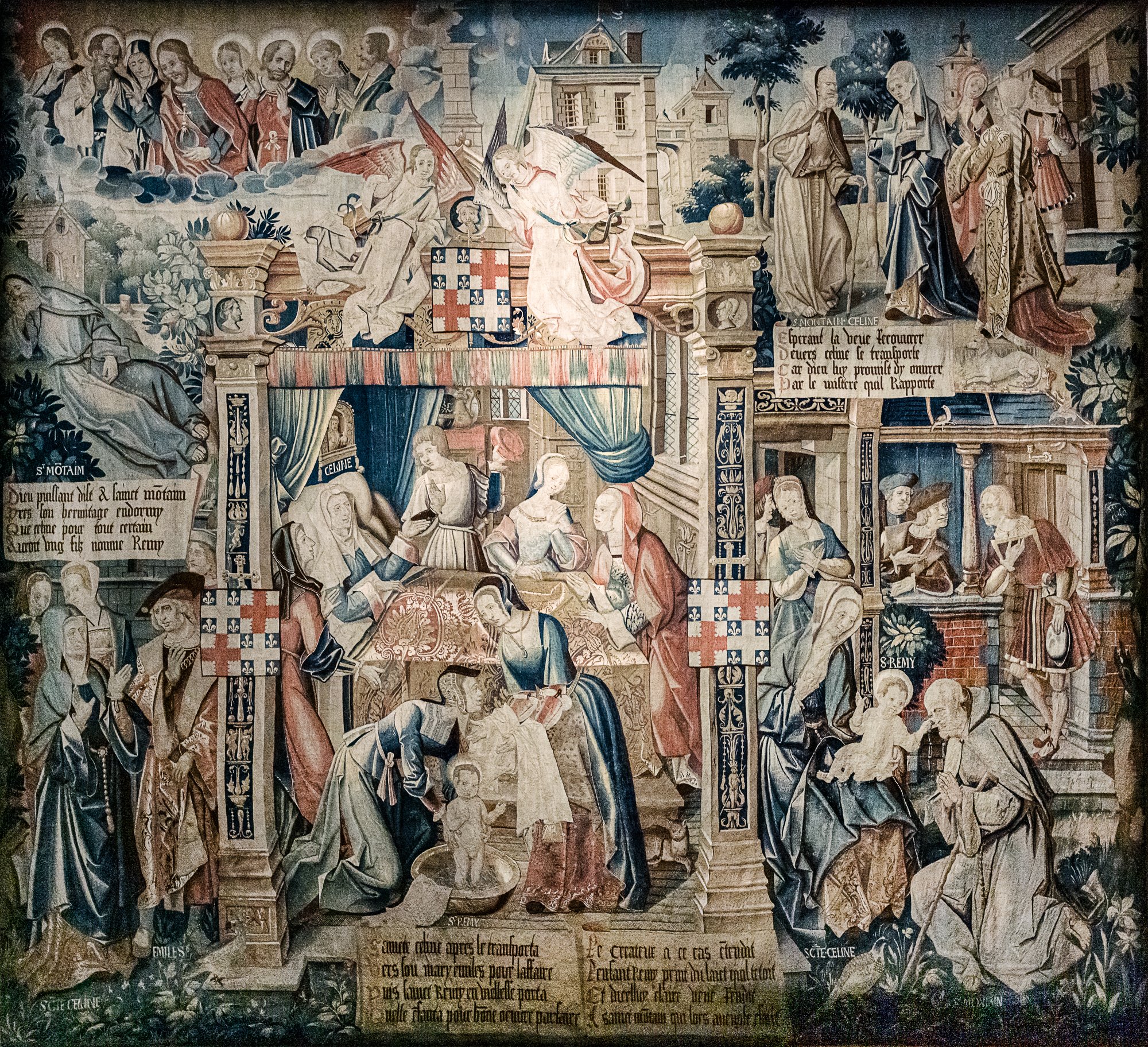
Birth of Saint Remy — The story unfolds in multiple scenes. At the center, Céline gives birth, surrounded by women attending both mother and child. Below, the infant is washed and presented. Around them, figures gesture and converse, suggesting that this is no ordinary birth. The imagery hints at prophecy and expectation: this child will grow into a figure of importance. The quiet domestic setting contrasts with the historical weight of what is to come.

The life of Saint Remy (Remigius of Reims) is not only preserved in texts—it was also woven, quite literally, into fabric.

In the early 16th century, a remarkable series of large tapestries was created for the city of Reims: the “Tentures de la vie de Saint Remi.” Comprising 10 monumental tapestries, the cycle tells the story of the bishop who baptized King Clovis and helped shape the religious and political identity of early medieval Europe.

These tapestries function like a visual narrative—almost like a medieval graphic novel. Each panel contains multiple scenes, accompanied by short texts in Middle French. Rather than showing a single moment, they unfold events step by step: birth, recognition, miracles, conflict, kingship, and justice.

What follows is the life of Saint Remy, told through these woven images—where history, legend, and moral teaching come together.

1. A Child Born into a Changing World

The story begins with the birth of Remy, presented as an event of quiet but profound significance. His mother, Céline, is surrounded by attendants, while the newborn child is carefully received and examined.

This is more than a domestic scene. It signals that this life is part of a larger design. In a world where the Roman order is fading, figures like Remy are presented as anchors—individuals through whom continuity and meaning are preserved.
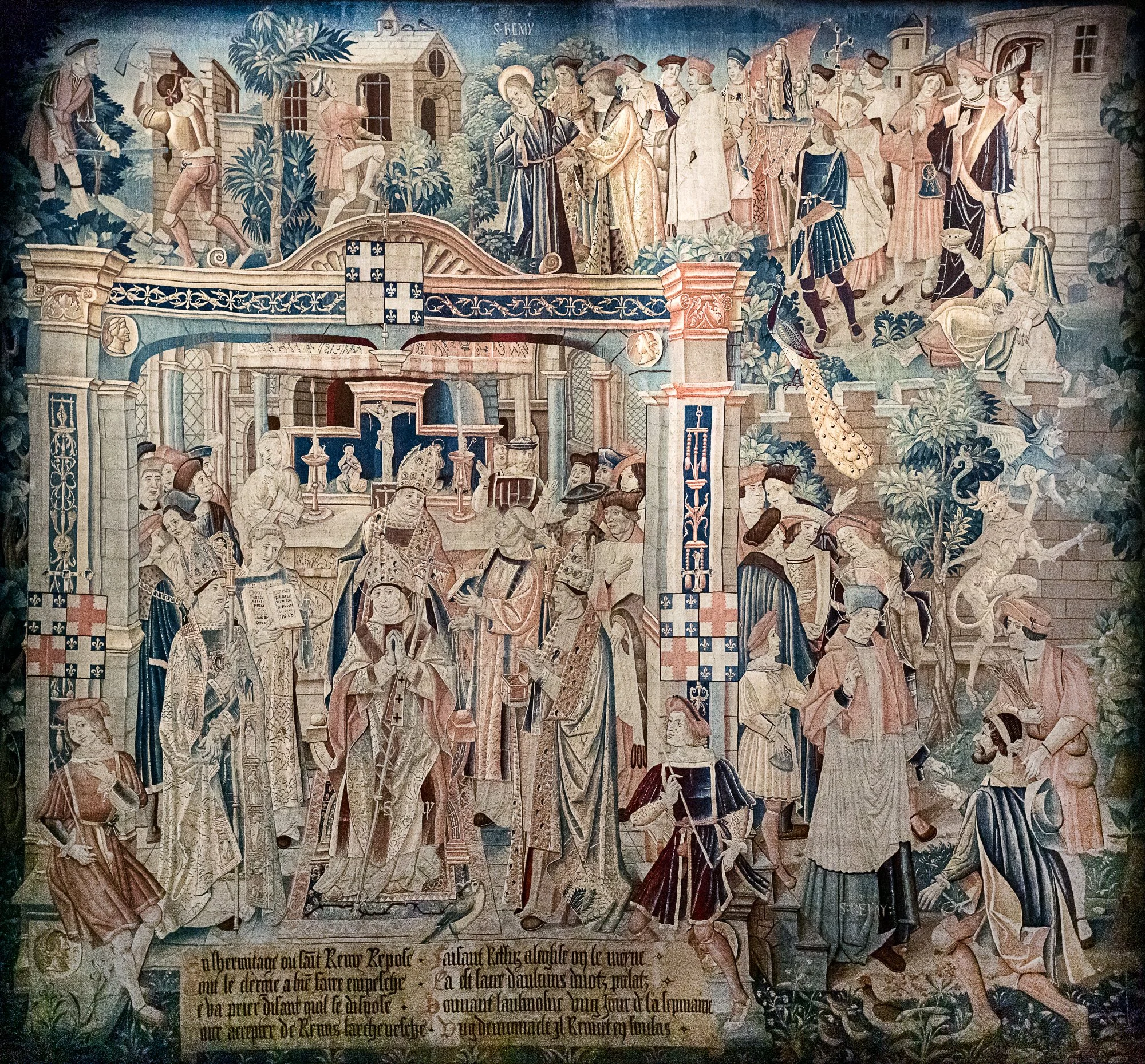
The Calling of Remy as BishopDifferent scenes show the recognition of Remy’s authority. Clergy gather, gestures indicate acceptance and blessing, and Remy is placed within a structured ecclesiastical setting. The architecture—columns, altars, and enclosed spaces—reinforces the institutional nature of the moment. This is not a sudden rise, but a collective acknowledgment. The young man becomes bishop, stepping into a role that is both spiritual and political.

2. Authority Recognised, Not Claimed

Remy’s elevation to bishop comes early and unexpectedly. The tapestries show a collective act of recognition: clergy and people gather, acknowledging his authority.

From this point onward, Remy is not only a religious figure. He becomes a mediator in a fragmented society—someone who can restore order where political structures are weakening.

His early miracles reinforce this role. Healing, intervention, and acts of restoration appear in sequence, building trust in a world where certainty is scarce.
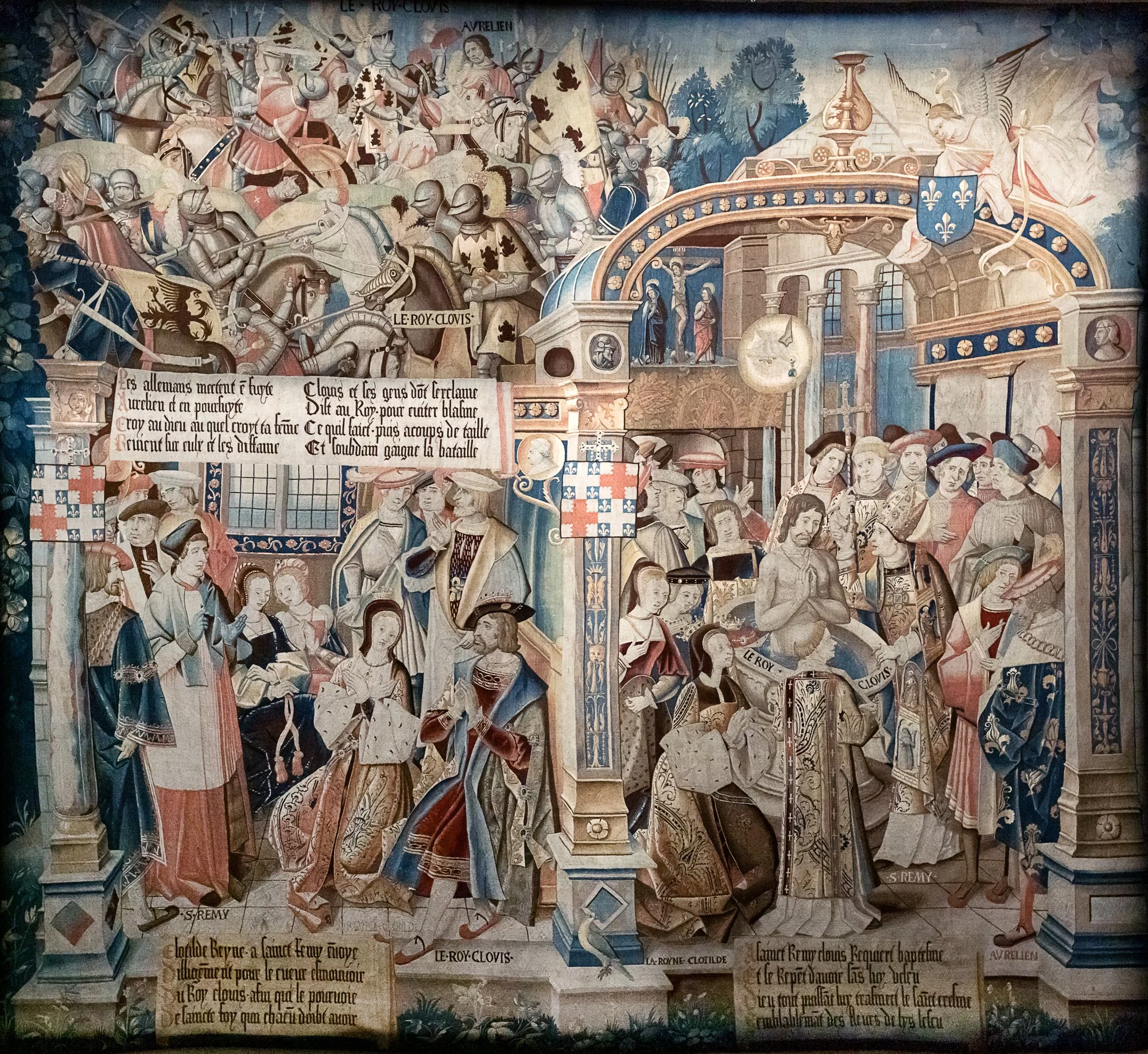
The Baptism of ClovisIn a richly structured interior, the baptism takes place. Clovis kneels, stripped of royal distance, as Remy performs the ritual. Around them, a carefully arranged audience witnesses the act—nobles, clergy, attendants. Architectural elements frame the scene, giving it a sense of permanence and order. This is both a religious ceremony and a political declaration: a king aligns himself with a new faith.

3. The King Who Changes Everything

The narrative shifts dramatically with the arrival of Clovis, king of the Franks.

The tapestries show a progression:

  • persuasion at court

  • crisis in battle

  • a vow made under pressure

At the Battle of Tolbiac, Clovis promises to convert if he is granted victory. The battle is won, and the promise is kept.

The baptism that follows—one of the most iconic scenes in the series—marks a turning point. In a carefully staged ritual, Clovis kneels before Remy. This is not just a spiritual act. It is a political transformation that will shape the future of Western Europe.
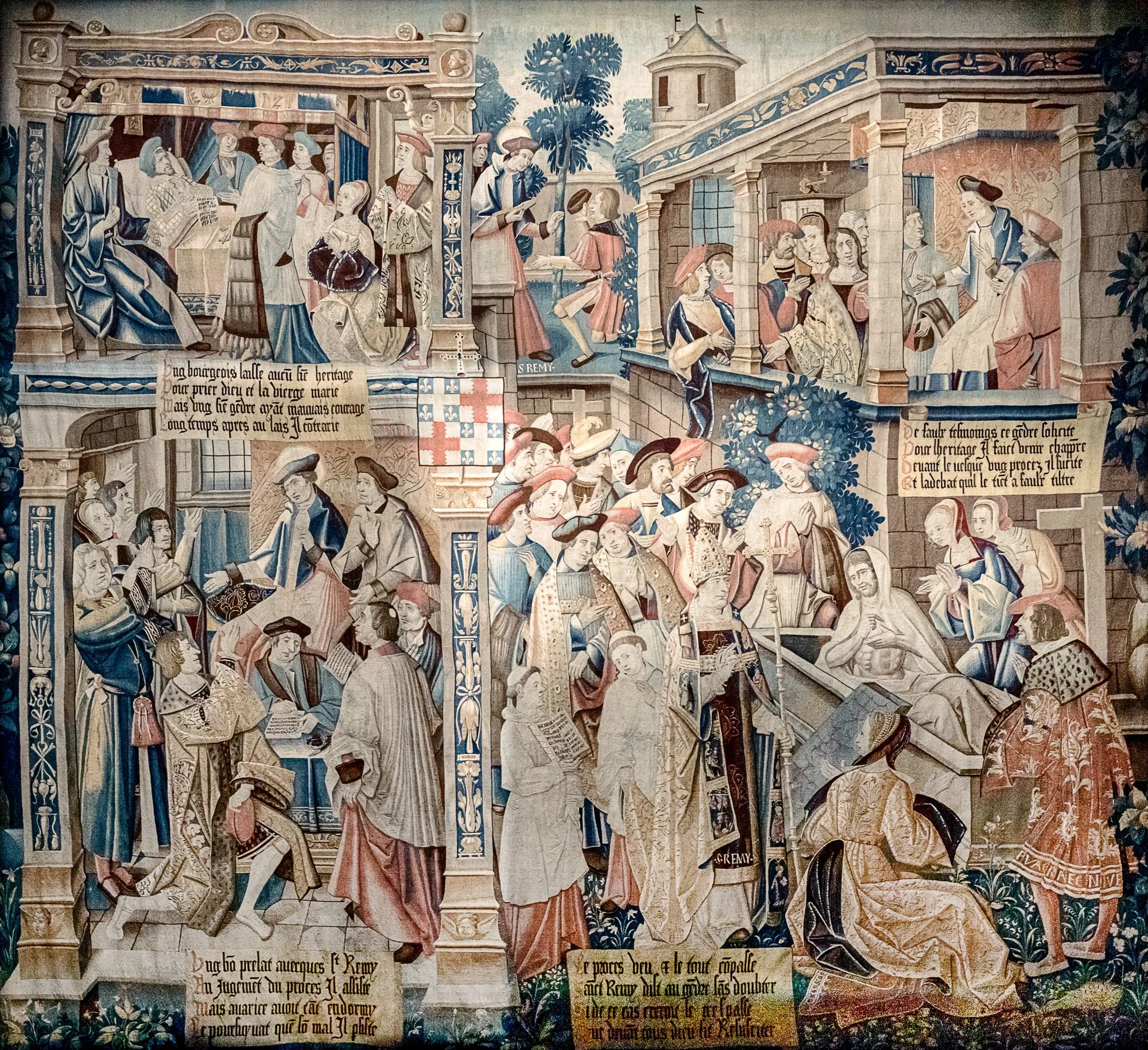
The Dispute Over the Inheritance —This tapestry unfolds like a legal drama. In one scene, a dying man lies in bed while family members gather—his wealth and intentions at stake. Elsewhere, documents are exchanged, and discussions take place around a table. Another scene shows a figure presenting arguments, possibly supported by false witnesses. Finally, authority intervenes—Remy and the king appear within a formal setting where judgment is rendered. The sequence moves from private death to public justice, revealing the fragile line between faith, property, and power.

4. Justice in a Human World

The final part of the story moves away from kings and into everyday life.

One tapestry presents a dispute over an inheritance. A dying man’s wishes are contested, false witnesses are brought forward, and legal arguments unfold. The scenes progress from private spaces—bedrooms and family gatherings—to public judgment.

Remy appears here not as a miracle worker, but as a moral authority. The case reaches royal power and is resolved. Justice is restored, but only after conflict and deception.

This closing note is significant. It reminds the viewer that holiness is not only about miracles or kings—it is also about how people act, argue, and live together.

A Life That Connects Worlds

Across the tapestry cycle, Remy stands at the intersection of worlds:

  • Roman and medieval

  • spiritual and political

  • divine intention and human action

His life is not told as a sequence of isolated miracles, but as a continuous engagement with society. These tapestries do not just celebrate a saint—they explain how order itself is created and maintained.

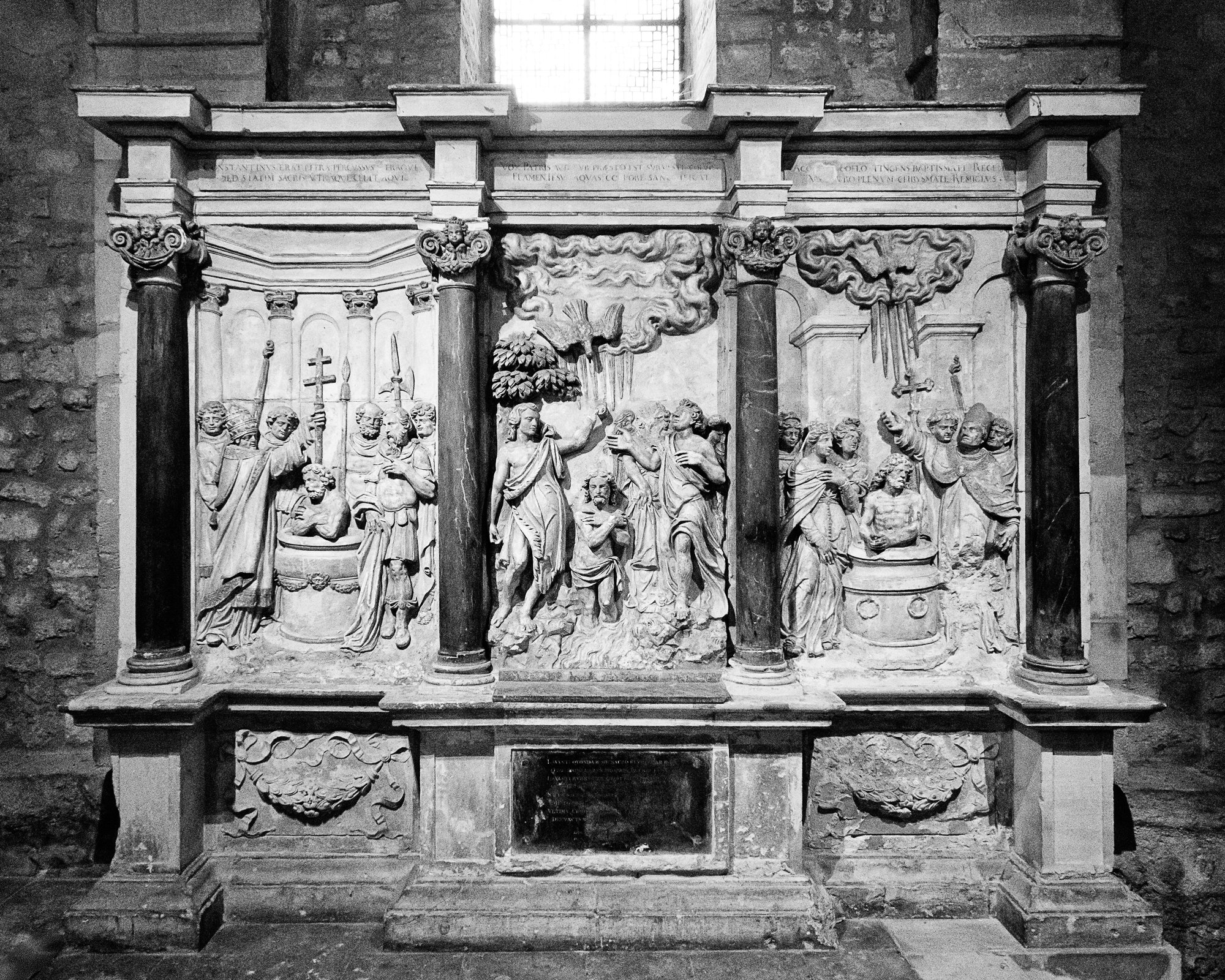
Clovis and the World He Lived In: Europe Between Empire and Kingdoms

Retable des Trois Baptêmes, 1610 — Basilique Saint-Remi, Reims (France), attributed to Nicolas Jacques

This monumental altarpiece can be seen today in the Basilica of Saint-Remi in Reims, one of the most important historic churches of France. It was created in 1610 and is usually attributed to the local sculptor Nicolas Jacques. The work stands in the former baptistery area of the church, where generations of visitors have encountered it as both a religious and historical statement.

The altarpiece depicts three key baptisms that together tell a powerful story. In the centre, Christ is baptised in the River Jordan by John the Baptist, representing the spiritual foundation of Christianity. On the left, the Roman emperor Constantine receives baptism, symbolising the moment when Christianity moved from a persecuted faith to a religion supported by imperial power. On the right, the Frankish king Clovis is baptised by Saint Remi in Reims, an event traditionally seen as the birth of Christian France. The work therefore presents not only a religious message, but also a political one: it connects faith, authority, and the formation of European identity through a visual narrative that links the origins of Christianity to the emergence of Christian kingdoms in Europe.

If you travel across Europe today — from the Rhine valley to northern France — you move through landscapes shaped by a long and uncertain transformation rather than a single dramatic event. Somewhere between the fading structures of the Roman world and the emergence of medieval kingdoms, a young Frankish leader named Clovis rose to prominence. His name is often linked to the birth of France, but his real importance lies elsewhere. Clovis lived at a moment when old certainties were disappearing and new forms of power, identity and belief were still being invented.

A World in Flux

The centuries before Clovis were not simply the “fall of Rome.” They were a period of slow change. The Roman Empire did not collapse overnight. Instead, it adapted, fragmented and gradually lost direct control over large parts of its western provinces.

One symbolic moment often mentioned is the winter of 406. Groups such as Vandals, Suebi and Alans crossed the frozen Rhine. Yet this was not the first time such groups had entered the Empire. The crucial difference was that this time many stayed. New communities settled inside the Roman world and became part of it. The old frontier between “Romans” and “barbarians” began to dissolve.

Gaul, the region that roughly corresponds to modern France, became a mosaic of peoples. Goths ruled in the south, Burgundians in the Rhône valley, and various Frankish groups lived along the Rhine. Many of these leaders still served the Roman Empire as allies or military commanders. They were not outsiders attempting to destroy a civilisation. They were participants in a changing imperial system.

In this new world, identities were flexible. A man could be a Frank, a Roman citizen and a soldier at the same time. Borders mattered less than loyalties, alliances and opportunities.

Violence, Crisis, and Opportunity

The 5th century was a time of insecurity, but also of innovation. Wars, migrations and power struggles reshaped society. Local elites struggled to maintain order. Cities declined in the north. Central authority weakened.

At the same time, new political models emerged. Leaders who had once commanded Roman troops began to take on civil responsibilities. When imperial administration disappeared in some regions, local strongmen became protectors, judges and negotiators.

This was not universal collapse. In many areas daily life continued. People farmed, traded, prayed and adapted. Christianity spread and became a powerful source of cohesion. Bishops, monks and saints increasingly played roles once held by imperial officials.

The Roman Empire itself did not simply vanish. Even after the famous year 476, many rulers in the West still recognised the emperor in Constantinople. Coins, laws and political language continued to reflect Roman traditions.

The world was changing, but its foundations remained deeply Roman.

The Franks: Not One People, but Many

The Franks were not originally a single nation. The name itself was given by Roman authors to various groups living near the Rhine. These communities could unite or divide depending on circumstances. They were farmers, warriors, traders and often Roman soldiers.

Over time their leaders gained prestige. Some served the Roman army. Others fought against it. Many did both. Their world was shaped by constant contact with Rome: military organisation, wealth, religion and political ideas all flowed across the frontier.

Clovis inherited this complex world. His father, Childeric, was likely both a Frankish leader and a Roman military commander. He operated within the late Roman system even as it weakened.

Clovis in His Own Time

When Clovis came to power around 481, imperial authority in north-western Europe had already become regional and fragmented. The scale of his domain was modest compared with the Roman Empire, and for most of his contemporaries he was simply one regional leader among many.

His achievement was not the creation of a vast empire, but the consolidation of power in northern Gaul. He managed to unite different Frankish groups, defeat rival rulers and expand his influence. He built a durable political centre in a landscape where authority had become local rather than imperial.

Perhaps his most decisive move was religious.

The Conversion That Changed Europe

Most rulers in the post-Roman West were already Christian, but many followed Arian Christianity, which differed from the Catholic faith of most Roman communities in Gaul. Clovis’ decision was therefore not simply between paganism and Christianity, but between different forms of the faith. Influenced in part by his wife Clotilde, a Catholic Burgundian princess, he increasingly leaned toward Catholic Christianity. Around the year 500, he was baptised in Reims by Bishop Remigius, a moment that marked both a personal conversion and a political alignment with the Catholic elites of Gaul.

This was a strategic decision. It aligned him with the Roman elites, bishops and urban communities of Gaul. It gave him legitimacy among the population he ruled. It opened alliances that strengthened his position.

Yet this choice was not inevitable. His family was religiously diverse. Pagan traditions still existed. The religious world of the time was fluid and contested.

His conversion helped create a new political and cultural synthesis: Roman, Christian and Frankish.

From Imperial Regions to Medieval Europe

Clovis did not replace the Roman Empire, nor did he rule anything close to its scale. What makes his reign significant is that it illustrates a broader transformation. Across western Europe, imperial authority was giving way to regional kingdoms that preserved many Roman practices while adapting them to new realities.

Clovis’ kingdom was one of several such experiments. But it proved durable. His successors maintained and expanded it. Over time this political structure became the foundation for later Merovingian and Carolingian power, shaping the development of western Europe for centuries.

The importance of Clovis therefore lies less in conquest and more in continuity and adaptation. He worked within the inherited Roman world, but in a context where power was local, identities were layered and institutions were evolving.

Why Clovis Still Matters

Clovis lived in a transitional age. His story shows that history is rarely about sudden collapse. It is about people navigating uncertainty, combining old traditions with new opportunities.

The Europe we know today — with its mixture of continuity and change, shared heritage and regional diversity — emerged from this long process.

Understanding Clovis means understanding that transformation.

Further Reading

  • Jeroen Wijnendaele, The World of Clovis

  • Peter Brown, The World of Late Antiquity

  • Gregory of Tours, History of the Franks

  • Guy Halsall, Barbarian Migrations and the Roman West

  • Chris Wickham, The Inheritance of Rome