worms

The Tree of Jesse in the Wormser Dom

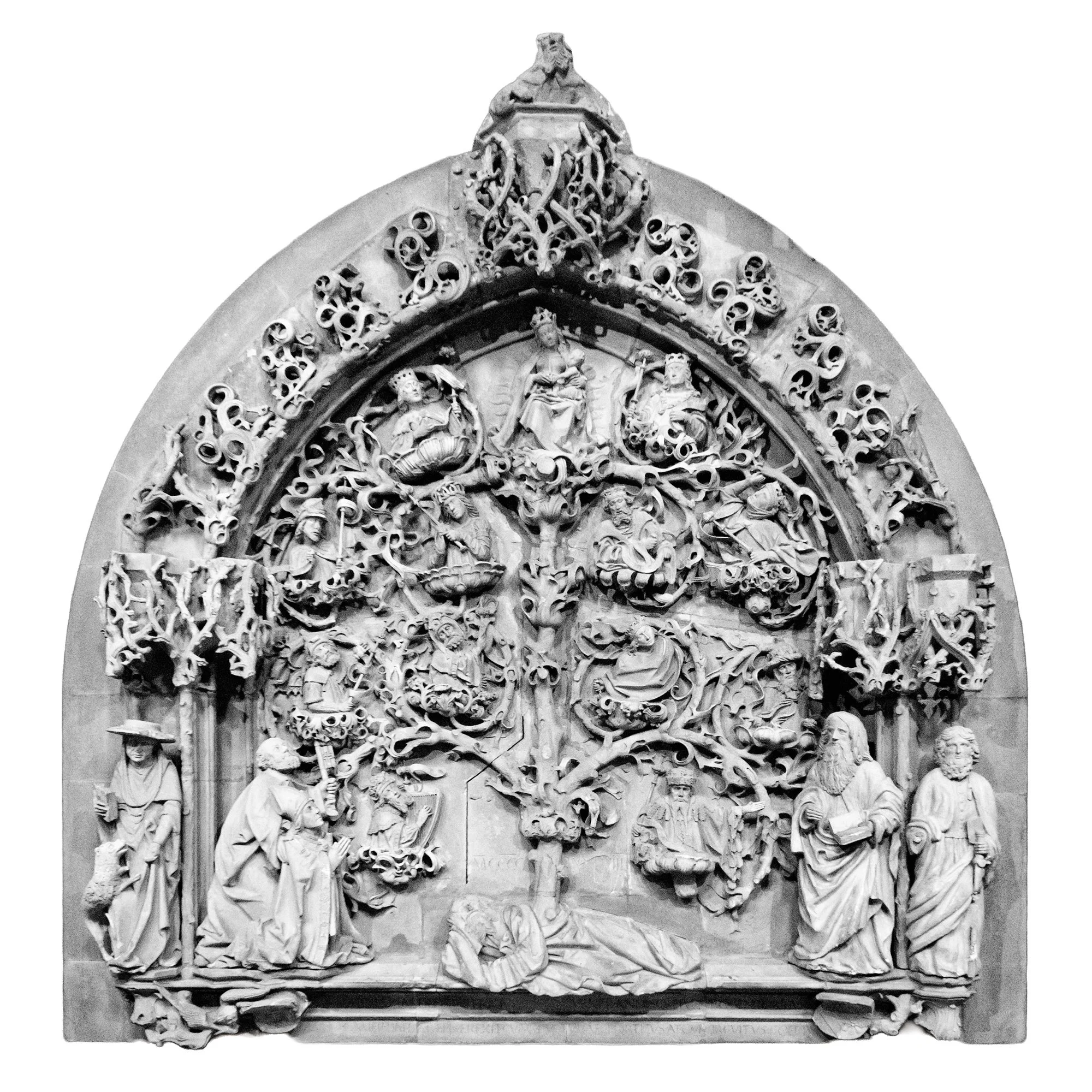
The Tree of Jesse in the Wormser Dom.

The relief of the Tree of Jesse in the Cathedral of St. Peter (Wormser Dom) presents the genealogy of the Holy Family with remarkable depth and grace.

At the base lies Jesse of Bethlehem, father of King David, from whose side a small tree trunk emerges. From this trunk rises a tangled yet elegant vine, filling the pointed Gothic arch with twisting branches and leaf-like crockets.

Along these branches sit or stand a succession of royal and prophetic ancestors of Christ, each set within the foliage:

  • King David, often depicted with a harp

  • King Solomon, wearing a crown and holding a scepter or book

  • Other kings of Judah such as Hezekiah, Josiah, or Zedekiah, marked by regal insignia

  • The prophets Isaiah and Jeremiah, holding scrolls with messianic prophecies

  • Figures sometimes identified as the Virgin’s parents, Joachim and Anne, or other key ancestors named in the Gospel genealogies

High above them all, at the tree’s flowering crown, sits the Virgin Mary enthroned with the Christ Child, the final and perfect bloom of Jesse’s lineage.

Flanking the arch are additional full-length figures:

  • Evangelists or apostles, recognizable by their books or scrolls

  • A bishop or abbot in mitre and vestments, possibly representing a donor or the ecclesiastical authority who commissioned the work

This exuberant Gothic carving is far more than decoration. It transforms Isaiah 11:1—“A shoot shall come out from the stump of Jesse”—into a vivid three-dimensional family tree. Its carefully portrayed kings, prophets, and evangelists link the Old Testament to the New, proclaiming Christ as both heir of David and fulfillment of ancient prophecy.
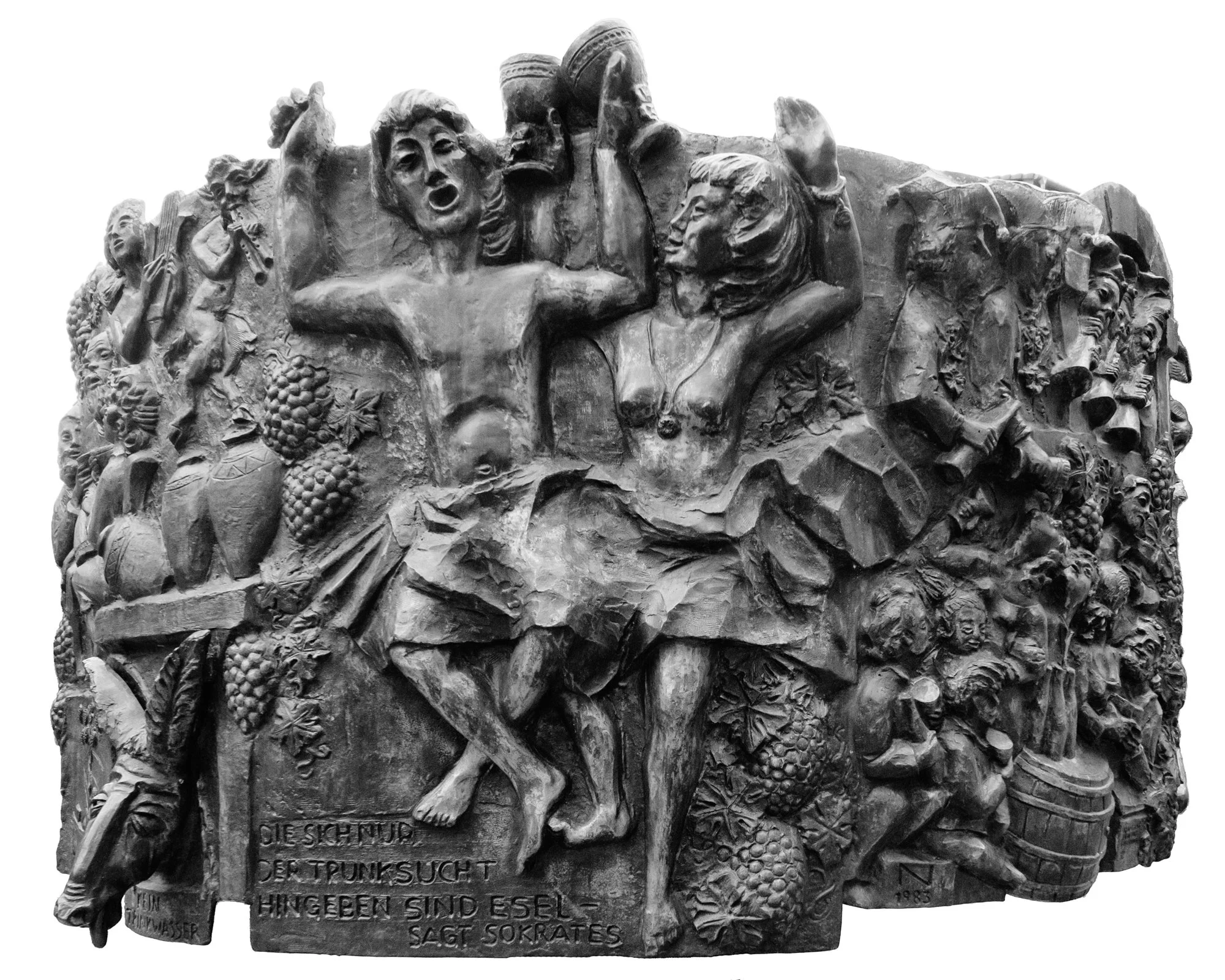
Street Wisdom from Worms: Socrates on Alcohol and Donkeys

Der Winzerbrunnen, 1983, by Gustav Nonnenmacher (Worms, Germany).

In downtown Worms you might come across a statue bearing the inscription: “Die sich nur der Trinksucht hingeben sind Esel, sagt Sokrates.” (In English: “Those who give themselves only to drunkenness are donkeys, says Socrates.”)

The message is as brisk as a Rhineland winter. A life reduced to alcohol is a life misused. The donkey—patient yet stubborn—embodies the very opposite of the reason and moderation Socrates championed.

It is an ancient Greek ideal recast as street wisdom, perfectly at home in a wine-loving city that also prizes learning and debate. In short: let reason, not drink, hold the reins.

Heiliger Sand (Worms, Germany)

Heiliger Sand (Worms).

The Jewish Cemetery in Worms, known as Heiliger Sand, is one of the oldest in Europe, dating back to the 11th century. It stands as a testament to the long and rich history of the Jewish community in Worms, which flourished from medieval times until its tragic destruction during the Holocaust. Worms was an important center of Jewish scholarship, particularly during the Middle Ages, attracting prominent rabbis and scholars, such as Rabbi Shlomo Yitzhaki (Rashi), who studied there. The cemetery contains graves from the 11th to the 20th centuries, including those of notable Jewish figures, and remains a symbol of Jewish cultural and religious resilience in Germany.

The Jewish community in Worms played a significant role in European Jewish life, with contributions to religious scholarship and trade. Despite facing repeated violence, e.g. during the Rhineland massacres (11th century), the community persisted for centuries, leaving behind a profound cultural legacy, now commemorated through sites like the cemetery and the Worms Synagogue.