sculpture

The Tree of Jesse in the Wormser Dom

The Tree of Jesse in the Wormser Dom.

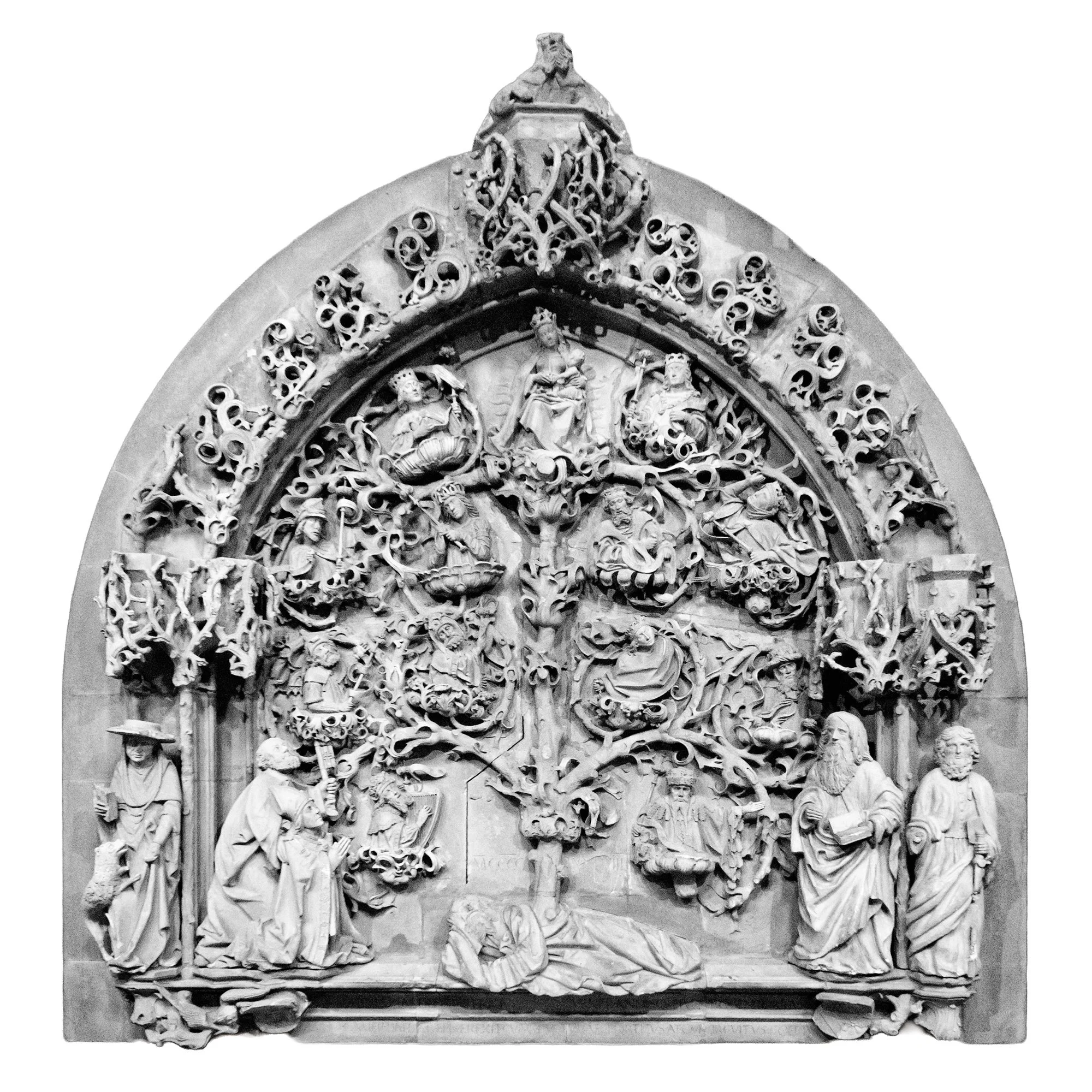
The relief of the Tree of Jesse in the Cathedral of St. Peter (Wormser Dom) presents the genealogy of the Holy Family with remarkable depth and grace.

At the base lies Jesse of Bethlehem, father of King David, from whose side a small tree trunk emerges. From this trunk rises a tangled yet elegant vine, filling the pointed Gothic arch with twisting branches and leaf-like crockets.

Along these branches sit or stand a succession of royal and prophetic ancestors of Christ, each set within the foliage:

  • King David, often depicted with a harp

  • King Solomon, wearing a crown and holding a scepter or book

  • Other kings of Judah such as Hezekiah, Josiah, or Zedekiah, marked by regal insignia

  • The prophets Isaiah and Jeremiah, holding scrolls with messianic prophecies

  • Figures sometimes identified as the Virgin’s parents, Joachim and Anne, or other key ancestors named in the Gospel genealogies

High above them all, at the tree’s flowering crown, sits the Virgin Mary enthroned with the Christ Child, the final and perfect bloom of Jesse’s lineage.

Flanking the arch are additional full-length figures:

  • Evangelists or apostles, recognizable by their books or scrolls

  • A bishop or abbot in mitre and vestments, possibly representing a donor or the ecclesiastical authority who commissioned the work

This exuberant Gothic carving is far more than decoration. It transforms Isaiah 11:1—“A shoot shall come out from the stump of Jesse”—into a vivid three-dimensional family tree. Its carefully portrayed kings, prophets, and evangelists link the Old Testament to the New, proclaiming Christ as both heir of David and fulfillment of ancient prophecy.
The Mystic Mill, Vézelay (France)

In the Basilica of Saint Mary Magdalene in Vézelay, many column capitals are decorated with depictions of Christian stories. The representation shown in this picture visualizes the story of the Mystic Mill. It depicts two figures. One pours grain into a mill, and the other collects the processed flour in a bag. The image is unique in Romanesque sculpture and does not seem to depict any known biblical story. However, a stained glass window in the Abbey of Saint-Denis (France), created around 1140, identifies the figures in this representation as Moses and Saint Paul. This identification helps understand the image as an allegory of the transformation of the Old Laws from the Old Testament to the New Laws of the New Testament. The cross within the mill-wheel symbolizes the transformation process of the mill and Christ's journey to the cross.

Cathedrals and Churches, Medieval Internet hubs focused on Storytelling

Interior of Église Saint-Martin, Veules-les-Roses (France).

Cathedrals and churches, adorned with statues of saints and imagery, functioned as medieval equivalents of internet sites, seamlessly connecting individuals to a vast network of stories and teachings. Just as one navigates through web pages, visitors to cathedrals could explore the narratives depicted in sculptures, paintings, and stained glass windows. Each saint or image served as a portal to a distinct storyline, offering moral lessons, accounts of miraculous deeds, and examples of piety. Pilgrims and worshippers had the opportunity to access this treasury of tales, fostering a connection with the spiritual and cultural legacy of their community. In essence, cathedrals served as pivotal centers of information and inspiration, granting entry to a rich reservoir of religious and moral wisdom, much akin to browsing the web for knowledge and enlightenment.

Altarpiece by Juan de Valmaseda (1524), Cathedral of León (Spain)

Roman "Head", Museo Nacional de Arte Romano, Merida (Spain)

Sculpture of the head of a Roman man - MNAR 6372 - Museo Nacional de Arte Romano, Merida.

For two millennia, his gaze holds fast,
A Roman's likeness, sculpted to last.
Through epochs of change, his eyes still gleam,
A portrait of time, a silent dream.

In marble, he stands, a frozen glance,
Across centuries, his form enchants.
From ancient days to modern sight,
His presence bridges time with might.

Though ages pass, his essence endures,
A testament to art's timeless allure.